The Koi of Constant Distraction

Clearly this whole “time management” thing and I need to sit down and have a long talk about priorities. I promise you that if I go off on how much I have to accomplish this month (or this week) one more time, you’re all going to throw your hands up and walk away. Or thwack me with something. Trust me, I’m as frustrated as you are. (Thankfully the GRE, at least, has been sweetened with a few carrots to keep me studying.)

This is going to be a short one. I’m all out of juice at the moment, but that’s only because I’m saving it for edits tomorrow.

I don’t know what, precisely, the Koi of Constant Distraction are, but you know as well as I do that they’re real.

Last week was the world’s most awkward dinner party. It’s hard to enjoy yourself when you can’t figure out why one guest is your best friend’s evil twin and whether the other is trying to overthrow the government. How will Imogen and Posthumus come through that? (Bonus: If you liked the previous chapter’s title, this is the source. That whole scene is pretty golden, but then, I have a terrible soft spot for Cloten, wretch that he is.)

One song

“Pine Moon” by Feist [lyrics]

Not only is this the song that got me through the last 900 words on repeat, but to a certain extent it also captures the shivery feel of the wrongness of Imogen’s nightmare. And now that I’ve read the lyrics, they seem appropriate too.

Two links
It’s easy to get caught up in atmosphere and details when the history behind them is so engrossing. My newest time-suck is MapsOf.net, which, very handily, has a simple map of Roman Britain around 410 CE. That’s much later than the historical Cunobelinus lived, but, like Shakespeare, I embrace rampant anachronism with open arms.

We can’t, of course, forget the whole steampunk side of things. At precisely the right moment, as I was stuck over figuring out what, exactly, the Hall of Public Records looked like in my Londinium, Tumblr came through and supplied one doozy of a visual reference.

Three lines

Posthumus contemplates the remains of his breakfast. “You can’t bribe me with picnics, and you can’t bribe me with pie. I can definitely be bought for libraries, though.”

I will catch you on the flip side, my friends. If this all makes you wonder what these have to do with the story, check back on Tuesday for the next chapter. As always, no knowledge of steampunk or Cymbeline is necessary to enjoy Innogen and the Hungry Half, but if you’d like to read the play, MIT has the full text available for free online.

GRE is to career planning as escalation is to…

If a protagonist has only one problem to sort through, there isn’t much of a plot. It’s by layering demands on our heroine that a story becomes interesting, especially if they’re in competition with each other. Apparently I am taking this formula to heart, because in addition to work, in addition to this project and in addition to trying not to become a hermit who can’t cook for herself, this week I accidentally signed up for the GRE.

“Accidentally” is a strong word, but it’s nearly accurate. One minute I was reading about application deadlines, the next I was giving my credit card to ETS. To put that in context, I’ve been resisting grad school since about 2005. I’ve always known I wanted to go, but I don’t want to be in academia, and I knew I couldn’t justify more school (and more debt) unless I was certain the degree would steer me toward a real career. Thanks to a recent graduate school fair organized by Idealist.org, I think I’ve finally found it — or rather, I’ve now got the name for the thing I’ve wanted to do all along. Which is great — a huge relief! I finally have a path, a plan, a set of options to pursue.

I also now have the GRE to study for, applications to compile, essays to compose, visits to arrange, decisions to make. This on top of work, friends, family, freelancing and Innogen. It was the right decision, but my timing is hilarious. Onward!

Last week Imogen got quite the suckerpunch, meeting Cloten, who looks just like her best friend and acts nothing like him. Let’s see how she’s going to deal with that!

One song

“Bang Bang (My Baby Shot Me Down)” by Nancy Sinatra [lyrics]

Hey, remember that time when your certainty in the most solid thing in your life got yanked out from under you? Man, that was rough. Poor Imogen. Now she has to spend an entire dinner party with it.

Two links
I’ve mentioned before that most of my knowledge about the Roman Empire comes from the Asterix comics, which means my general idea of what food in Ancient Rome looks like is something close to this:

From Asterix in Helvetia

Luckily there are scholars who disabuse us of hilarious, parodic simplifications, and who publish cookbooks of actual recipes from imperial Rome! I’ll never be embarrassed by my ignorance of how to properly cook an ostrich again. By Toutatis, I’m relieved.

The second link is mainly visual, and explains why I’m really writing Innogen.

Three lines

“Even Argus wasn’t invincible when Mercury came to play him to sleep.”

Rigantona smiles. “The Romans have gods, stories and much else, Lady Imogen, but I assure you, they do not have this.”

That’s it for now. Swing back Tuesday to see how it all comes together! As always, no knowledge of steampunk or Cymbeline is necessary to enjoy Innogen and the Hungry Half, but if you’d like to read the play, MIT has the full text available for free online.
Just like a corgi on a whale-watching boat

Confession time: I’m not sure what’s going to happen next week.

Sorry, that’s a bit of a fake-out. I know where Innogen is going. I’m just not certain how it’s going to get done. See, this has been an odd month for me; there have been a lot of holidays at work, and several times now I’ve had the luxury of spending four straight days pounding out a draft or gnawing away at notes or obsessively line-editing. But that’s all in the past now: my next weekday break will be Thanksgiving, which presents its own delights and challenges. (I get to see my parents! My dog! My nieces from Seattle! I… don’t know when I’ll have two minutes to myself!)

There’s time yet to set up a routine, as I tell myself, and that’s my goal for the coming month. If I can cut out my Tuesday activity (obsessively checking stats after posting a new installment) and replace it with planning and outlining, that means three or four days for drafting and two or three days for honing. One thing I admire about web comic creators is their ability to produce on a consistent — and quick — schedule. That’s discipline. Fingers crossed, I can follow their example.

Second confession: I am so grateful and thrilled and overwhelmed at the response to the first chapter of Innogen and the Hungry Half. To all who have read, and commented, and contacted me over Twitter and email and Tumblr, thank you. I can’t tell you how much your words mean to me. To those who have shared this story with your friends, loved ones and readerships, my undying gratitude! There will be more — if you’re digging the story, please keep spreading the word. (If you’d like to recommend this story to your network of choice, please know that it is one of several ways straight to my heart. I so appreciate any and all word of mouth. If you don’t like it, tell your enemies!)

“Not imagined, felt” was a big day for Imogen and co. (For the curious, this is the source of the chapter title.) Here’s a hint at what’s coming for her next.

One song

This week I’ve been thinking a lot about Aaron Sorkin. I’m stealing some key components of this story from The West Wing, and recently had the revelation that if Imogen is a much politer Josh Lyman, then Posthumus is clearly Donna Moss. That pleased me. But my first Sorkin show was Studio 60, and early in that run, Matt Albie, head (and sole) writer of a 90-minute comedy revue, realizes he has to repeat his feat every week. At first it’s exciting. Then he turns to pills and self-pity.

Maybe I shouldn’t think about Studio 60 right now.

Two links
This was not intentional, but it’s been a heck of a week to do searches on Libya. I poked around and found a stunning slideshow of Roman ruins in the old city of Leptis Magna. They were published in the context of whether they might survive the war for independence, which has just taken a rather stunning turn with Gaddafi’s death.

In less charged news, I’ve been learning a lot about starfish lately — including the fact that we’re supposed to call them sea stars, as they’re not fish. Either way… just saying.

Three lines

Dr. Cornelius advises the king on scientific matters, while the king funds his research, the shape of which seems Protean. At present, it involves open tubs of briny water, and a half-finished dissection somewhere close by. He looks somewhat shyly toward the mess.

Yes, I had to dissect starfish/sea stars in high school biology. My teacher didn’t give us any directions: we just came into the classroom and there they all were in a bucket, waiting for us. I made a complete hash of it, and felt awful for years after that I had turned what had formerly been a living, eating, probably sentient creature into an indiscriminate pile of mush.

I hope you’ve enjoyed these teasers. Come back Tuesday to see what they all mean!

Hi! You don’t have to know anything about steampunk or Cymbeline to enjoy Innogen and the Hungry Half, though of course, if you’d like to read the play, MIT has the full text available for free online. For a lighter, quick summary, you can watch the short video linked at the bottom of this post. I assure you the original text is exactly that ridiculous, wonderful and strange.

Teasing: The second best part

Ironworks over Chicago River

To date, I have attempted five rounds of National Novel Writing Month. I’ve been a winner twice, which came at the heels of a solid month of no socializing; even my parents know I’m usually doing something that requires alone time during Thanksgiving. Last year I decided to stop, because while quickly writing 50,000 or more words of a story you’ve been idly dreaming up is incredibly satisfying, it’s also a recipe for six months of burnout, at least for me.

However, I will always be grateful to NaNo for slapping my fear of the blank page out of me. It’s done marvels for pushing me to stare down a new document and put some words on it. One of the reasons I started “Innogen and the Hungry Half” was because I wanted a big project, something that’s been thin on the ground for me this year. I’m thrilled to share that the first chapter should, barring catastrophic edits, be up for your delectation early next week. (Even if the edits are catastrophic, I’m one of those nerds who lives for editing. I love it. It’s like a puzzle for me.)

As I geared up for putting those first sentences on the page, I could feel NaNo roaring away in the back of my head. It sounded like Led Zeppelin’s “Immigrant Song”: Valhalla, I am coming! I’d spent weeks thrashing out reams of notes, going in circles, unable to get the shape of the thing. I tried starting in about three different places, none of them right. In the end, it meant sitting in my chair and telling myself over and over and over again that it didn’t have to be perfect, not yet. On the first day, I got about 500 good words (which became 700 around bedtime, because naturally that’s when lines start to flow); on the second, 700 more. Yesterday, I did a full-on 1700. NaNo has trained me well.

Now, of course, the real work comes, because while I’ve had the beginning minutely envisioned for a while, the lumpy middle now stretches before me. Now comes the fun part! (She says, semi-wretchedly, laughing as she does so.)

In the spirit of experimentation, and also of my love for previews, teasers and trailers, I’m kicking off what should be a weekly feature, in which you all get a glimpse of what’s going into the writing and — oh yes — the seat-of-my-pants research. (Wikipedia, let me love you.)

One song


“One Beat” by Sleater-Kinney [lyrics]

I worked at a student coffee shop in college, and a group on constant rotation with one particular cohort was Sleater-Kinney. I hated them as much as they hated my Bjork, but this track redeemed the shift every time. It’s fierce and beautiful and it’s either about nuclear energy or fractal geometry. Either way, it’s a great thematic pace-setter, which I hope, in a story about Shakespeare, makes you curious!

Two links
I’m a nerd, but I have some big gaps in my knowledge base. The largest of these is anything to do with Ancient Rome. I’ll blame learning to read on Asterix comics: I could never root for the empire! Luckily for me, I not only have Classics-nerd friends to pester for help, if it comes to that, but I also have Roman-Britain.org. It’s not snazzy, but it is informative. I came for the Latin abbreviations (which I find fascinating!), I stayed for the lifeline to world-building.

Another gap in my knowledge base: steampunk everything. I’m skimming through a lot on Tesla coils and the Great Exhibition of 1851, but one of the neatest sidetracks has been learning about early animation — specifically, the praxinoscope. It’s a one-off detail in the story, but I really like how it looks. There’s something sort of eerie and dreamlike and lovely about it.

And, because YouTube contains all things: yes, it comes in the steam-powered flavor too.

Three lines

“But is that life? The most vital connections come to us by speech, which cannot be touched, even if it can be felt.

“I propose a future cut like the Gordian knot.”

So that’s that! Intrigued? I very much hope so. Again, barring catastrophe or natural disaster, the first chapter should be up early next week. You don’t have to know anything about steampunk or Cymbeline to enjoy the story, though of course, if you’d like to read the play, MIT has the full text available for free online. For a lighter, quick summary, you can watch the short video linked at the bottom of this post. I assure you the original text is exactly that ridiculous, wonderful and strange.

Hope you all have a marvelous weekend — catch on the flip side, chapter in hand!

Not entirely swanlike

I’m feeling a bit swanlike over here these days — not in the sense that I’m graceful, or secretly vicious and cranky, but in the sense of appearing to just float when in fact I’m furiously paddling. Is that swans? It might be ducks. As you can see, I’m consumed with big questions.

When I’m not banging my head against my outline for “Innogen and the Hungry Half,” I’m trying to come up with ways to provide background on the project for my readers. I don’t expect everyone coming in to know anything about Cymbeline, one of Shakespeare’s more obscure plays, and even I don’t have all the answers when it comes to explaining steampunk. True fact: for about five minutes at the end of college, when I was desperately grasping for some idea of a career to pursue, I thought I might be interested in dramaturgy. I sought out some theater internships, though the one I got was in New Works, which may have been right for me anyway. Anyway, I believe one of the responsibilities a storyteller has is to teach the audience about the story and how to read it. In the story itself, this comes from good world-building, but since this is the internet, I’m also kind of excited to put together some subject guides for the curious. (Anything that gets more people to read my secret favorite play!)

Some of this means to turning to my friends, who are a collective of riches in every respect. When I talk to people outside my general group about this story, I find that very few of them have heard of steampunk, probably because not everyone is, like me, on the internet for most of their waking hours. I could send them to Tor’s Steampunk Week page, which ends today, or the fantastic and fascinating Beyond Victoriana. I could try and ramble about pseudo-Victorian alternate histories and how the most interesting of these stories deconstruct and subvert power structures and conventions. Or I could go with one friend’s quip that steampunk is what happens when goths discover brown. In the end, I’m still learning myself, and while the decision to set “Innogen” in a steampunk universe is a conscious one, maybe I’d be better served writing that essay when the story is already out there.

These are the things I think about! I’m also in the process of trying to explain Cymbeline in a straightforward manner, because it’s one of Shakespeare’s most ridiculous, overwrought plots, and that’s partly why I adore it. Wikipedia actually has a fairly good rundown, but really, if you want to appreciate how gloriously convoluted this play is, take ten minutes with this fantastic video from The Geeky Blonde:

If you liked that, one of the reasons it’s been a bit quieter over here (other than my constant scheming about this story) is that I’ve been playing around with Tumblr and Twitter a little more. I am definitely looking for more ways to interact with people and share neat things I’ve found, so if you’ve got an account at either or both sites, I would love to hear from you. The Tumblr especially is a great adjunct to this site, because it’s such a great curatorial tool for finding nifty things around the web. Some of my favorites so far include street art from around the world, real airship hotels shaped like whales, real places that shouldn’t exist, one hundred years of fashion in 100 seconds and any number of stories I would like to read or write.

So yes, please keep in touch! Things are fairly churning behind the curtain, even if I’m mixing metaphors there, and you might even get some nifty Magpie & Whale goodies before they make it over here, if they do it at all. Hey, it’s happened before! Hope to see you around, lovelies. Esther signing off.

Tumblr: magpieandwhale.tumblr.com
Twitter: @magpiewhale

Recursive inanity; or, Jonathan Franzen, you are wrong

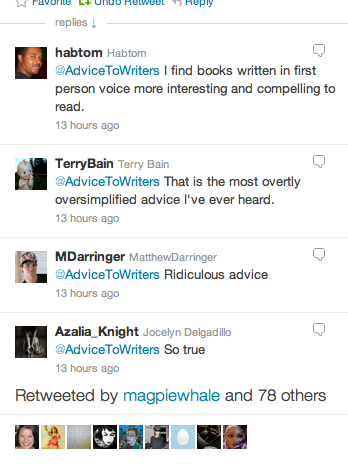
If you were hanging around Twitter when I woke up this morning, you may have seen me get extremely grumpy about a quote from Jonathan Franzen. “Write in the third person,” he says, according to @AdviceToWriters, “unless a really distinctive first-person voice offers itself irresistibly.”

Having just rolled out of bed, I responded in the normal, reasonable way: by getting huffy.

@magpiewhale Not going to lie, this makes me want to write first person out of spite and make it amazing. POV “standards” just. That irritates me.

@magpiewhale Pardon my mulishness, I just woke up. But issuing quips on what you should default to unless you’re extraordinary limits experimentation.

@magpiewhale Not to mention discovery! So I say ignore Franzen and try anything. You’ll figure out what works for your stories.

As I thought about it later, I began to wonder if perhaps I’d skewed Franzen’s meaning a little. Perhaps he’s not being as condescending as he sounds, I thought. Maybe he isn’t speaking to the audience I assume he is, i.e., burgeoning writers. I’ve never read his work, and given the unbearable hype (and boorish subject matter, from what I see of reviews), I don’t actually plan to do so. But I do know how acclaimed he is, for whatever reason, and that his word supposedly carries a note of authority.

Either way, being prescriptive about point of view is irritating and limiting, I feel. As I said in my tweets, artists need to feel free to experiment. If “poorly done” first person is so offensive to a delicate reader’s eye, they’re free to walk away and the writer is free to learn from the experience.

I kept mulling it over, though. And the more I considered the statement, the more inane I found it — because any writer who is exploring a character finds that voice distinctive and irresistible. That’s why they’re using that voice, whatever the POV. The interest is inherent.

All that said, the incident has convinced me of two things. One, I am free from any obligation to read Mr. Franzen’s work. Two, I am thoroughly pleased with my now firm decision to try “Innogen and the Hungry Half” in the first person. It’s not a perspective I use very often, but I look forward to pushing myself with it.

As I congratulate myself for using the word “free” so much in this post, in homage to Mr. Franzen’s latest opus, I have to laugh at myself too. I may disagree with this little bon mot, but in the end, I’m no more authoritative than he is.

eta: Late this evening, @AdviceToWriters posted a different quote that I think is much, much more useful and inclusive.

There are so many different kinds of writing and so many ways to work that the only rule is this: do what works. Almost everything has been tried and found to succeed for somebody. The methods, even the ideas, of successful writers contradict each other in a most heartening way, and the only element I find common to all successful writers is persistence—an overwhelming determination to succeed.

SOPHY BURNHAM

“But clay and clay differs in dignity / Whose dust is both alike.”

I’ve been moping for almost a month now about how I need a new project. The novels are nonstarters, the art is thwarting me and even my resolution to take advantage of Chicago’s cultural offerings hasn’t entirely stuck.

The solution is simple, then: conceive of something straightforward yet grandiose, announce it in front of the whole world, and commit to do it in full view of the public. I would like to try writing a serialized novella, and to post it on a regular schedule here. Since coming to this conclusion on Sunday evening, I’ve been riding the wave of joyous certainty that comes from having a project to plan. I’ve decided to attempt a story I meant to write but never did: a “fork,” if you will, of William Shakespeare’s Cymbeline, set in a steampunk universe.

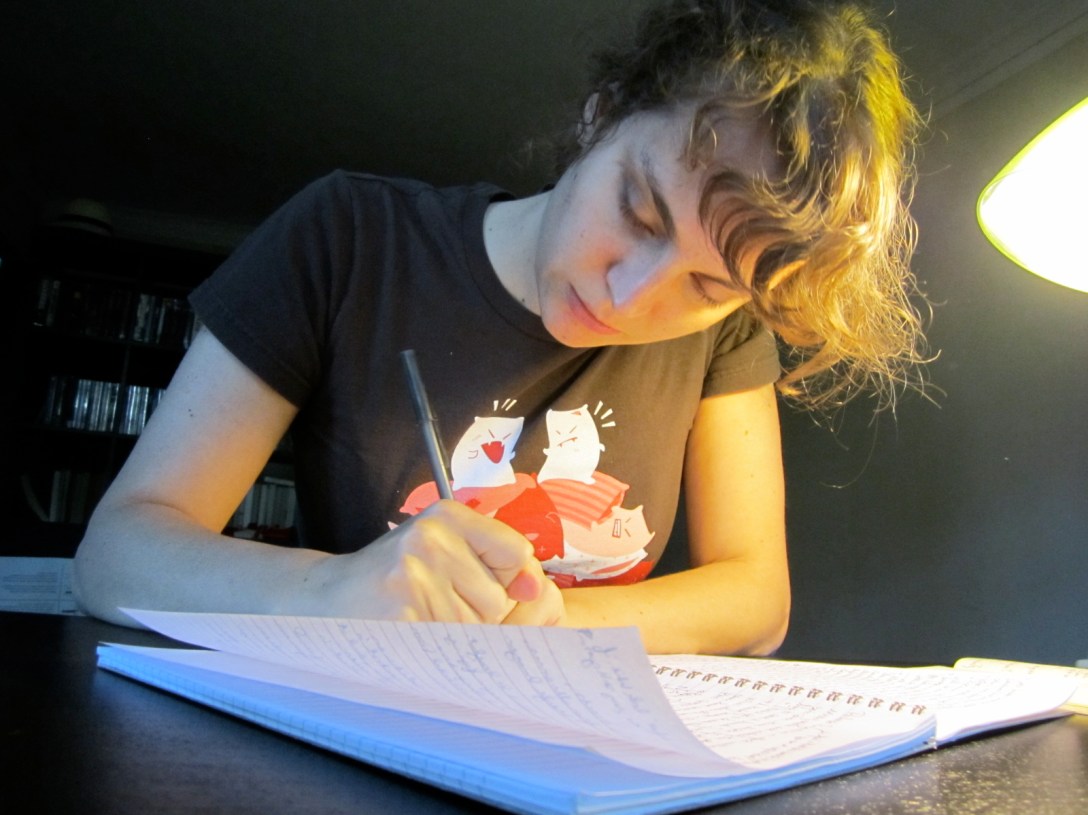
I’ve never written steampunk before. Truth be told, I haven’t read much either. But I’ve got about five pages of notes, as seen in the illustration above, and I’m ready for an adventure. The story is called “Innogen and the Hungry Half,” which I hope intrigues you, and keeps you coming back for more. Posts will go up at least once (and I’m hoping twice) a week, probably on Tuesdays and Fridays, and I very much hope it becomes a participatory experience. (Translation: I love to hear from you, hi!) You can always find me on Twitter (@magpiewhale), and you can also now follow me on Tumblr (magpieandwhale, shockingly). (I really love Tumblr; I had a post all planned about how cool it is, especially for a site with “magpie” in the title. Then, appropriately enough, I got a bit distracted.)

So that’s it! If you’re totally unfamiliar with Cymbeline, that shouldn’t be a problem with this story, as it takes place before the events of the play. If you’d like to read the play, MIT has the entire text available for free; it is an amazing, hilarious, over-the-top late romance, in which Shakespeare steals liberally from every play he’s written thus far and parodies quite a lot of it, I think. If you’d like a brief trailer to whet your appetite, Cheek By Jowl has very helpfully provided such a thing, featuring the love of my life (who incidentally plays Posthumus and Cloten), Tom Hiddleston.

This double casting of the two male leads is actually what spurred the idea for the story in the first place. I hope to have a lot of conversations about this stuff as this project moves along. For now, though, I’ll leave it here, along with a plea to recommend your favorite Tumblrs to follow — including, if you wish, your own! Happy Monday, folks, and see you shortly in fair Lud’s-town.

Esther by genre

Elphine, a character in Stella Gibbons’ Cold Comfort Farm, spends her days dancing in fields, dressing in fanciful costumes and generally gadding about like a sprite of the woods. She also announces to the heroine, Flora Poste, that she writes poetry. Flora, being the wry Jazz Age society girl (and would-be author) that she is, discourages publicizing such a hobby, particularly to men. Myself, I prefer the opposite tack. If a fella can’t grok that I’m a writer and reader of weird things, we probably wouldn’t get along in the long term anyway.

My OKCupid profile announces near the top that I enjoy writing hard-to-categorize genre fiction. Last week, for the first time, someone sent me a message using that as his hook. How would I categorize my fiction, given the chance? I haven’t yet taken him up on the opportunity to explain in person, but I did start thinking about how I could break down my preferences in an easy-to-digest format.

This won’t be about steampunk or dystopias or paranormal romance. All I know for certain is that I consider myself a fantasy writer: it’s the broadest category that’s always made me happiest. My caveat is that I’m not generally invested in Tolkienesque sword-and-sorcery: my definitive introductory fantasy text wasn’t Lord of the Rings, but Redwall, which took me in some different directions. (As a sidebar, I’m the heretic who adores Peter Jackson’s movies but is bored by the books, save for The Silmarillion, which many people find impenetrable.) I tend to think there’s an internal logic to my genres. Here are my top five.

1. Epics. Blame this on Homer. The bigger and meatier the story, the more I can get lost in the world, the more I love it. The experience of immersing myself in something else entirely is one of the reasons I read and write. Quest stories in particular are really delightful to me, and given that I wrote reams of Redwall and Odyssey spinoffs as a kid, it’s no surprise to me that I have a hard time assembling novels in which the protagonists stay put.

2. Myth, folk tales and fairy tales. There’s something so fascinating to me about authorless stories that everyone within a culture knows. I love how potently these stories become connective tissue within a society, and I’m always impressed by how the telling of these stories is such an important part of the story itself. These are narratives as an act of power, and they change so much in relation to who tells them. That dynamism never stops moving me; I always want to engage.

3. Magical realism. I loved this genre for a long time before I knew the term for it. I’ve always been attracted to the tone and atmosphere of a story where everything seems normal except for one particular thing, or where something becomes literalized — cities are people, books are alive, God is dead and needs to be towed out to sea. The scale of magical realist stories is something I also find inviting: it can be as far-reaching or as personal as you wish.

4. Literary derivations. Two of my ongoing projects are radical reinterpretations of Shakespeare plays — not just retellings from another perspective, but taking those characters and their lives and putting them somewhere entirely new. I’m also working on a version of the Odyssey actually set in space, with all the considerations for psychology and culture that a modern audience demands. I honestly think the value of reinterpreting texts and engaging with them through storytelling cannot be overstated, no matter what the text.

5. Pastiche. I recently finished a story told in the style and conventions of a Jane Austen novel, and it was the most fun I’ve had writing in a long, long time. In the same sense that poetry with strict stylistic requirements gives poets a framework to break and play with, so too does taking on a voice decidedly not your own. The writing can just flow once you’ve figured out the style. It’s a neat way of combining elements of improv and collage, in that you’re operating within a character more than dictating it, and that you’re playing with juxtaposition and combination.

As I look these over, the pattern I notice is how much I’m into reframing and world-building. Perhaps these aren’t as immediately marketable as “werewolf novel” or “deconstructing superheroes” (both of which I love dearly, don’t get me wrong!), but I find I’m not really nervous about that. Like Elphine, I know what I like, and when the time comes, if I can spoil the ending of Cold Comfort Farm a little, I’m confident I can land a guy — or an agent, knock on wood! — who gets that.

Don’t postpone joy.

I don’t remember whether it was for my birthday or for Christmas or some other occasion, but once upon a time a friend of mine gave me a do-it-yourself henna tattoo kit. It was a perfect gift for me, and I was really excited to use it. But I had this notion in my head, that it had to be used at the right time. I looked at the contents once, then put it in a closet, to use when I had an out-of-town friend staying over, maybe, or when I was with someone really dear to me.

The henna tattoo kit stayed in my closet for a long time. I always meant to use it, but somehow the time was never special enough. It wasn’t just something I could do one afternoon because I was bored; this was a present, and ought to be used accordingly. Of course, when I finally did open the package again and test it out – I don’t remember why – the ingredients had degraded, and all I got was a vaguely line-shaped splotch on the back of my hand.

Perfectionism has always been a thing with me, but I never knew the word applied until high school. On the one hand, it makes me incredibly pleased with the work I finish; on the other, it means it takes me a long time to finish just about anything, and even longer to start it. I have an ongoing deal with myself to try and be more satisfied with middle stages and messiness and uncertainty, with not insisting that I choose the timing of every moment of my life. Sometimes it works, sometimes it doesn’t. I try and take it as it comes.

I delay gratification a lot, often for really obscure reasons. Lately I’ve been bribing myself more, to just enjoy things as they come and not soldier on under the promise that someday I’ll deserve something nice for myself. Recently I bought a pair of what are quite possibly the raddest shoes I’ve ever owned, as a birthday present. Just last night I finally cashed in on a new iPod, which I hope will help with my Couch to 5K runs. Last week I attended my first class at StoryStudio, a writing center I’ve been wanting to explore for ages and never quite justified actually doing. (In going through some old emails, I discovered that I’d been on StoryStudio’s mailing list since March 2007, the month I moved back to Chicago. That feels satisfyingly bookend-y, in its way.) The class was on radio essays, and it was an excellent experience on a lot of levels.

My present to myself is feeling like Cab Calloway whenever I want.

This morning on the train, I found myself thinking of the Berenstain Bears. There was a particular book in which Brother and Sister Bear have to knock on the door of a frightening-looking house at the end of a neighborhood street. A witch lives there, or possibly just a mean old woman. Of course, once they do knock on her door, she turns out to be a lovely person who takes them under her wing, and they become friends. I’m not saying that I’m a perfectionist because I’m scared of trying new things, but it is a good reminder that trying new things, and being good to yourself, and not worrying quite so much about whether your experiences will be just as you plan or expect, is a good habit to cultivate.

It’s been a long couple of months since Magpie & Whale was active. A lot has happened, and a lot continues to happen, but nothing has stopped, nor should it. That’s something else I’m working on. Welcome to the flip side, friends. Nice to see you again.