Miraculously, down its own street: Why I love dogs

Every day, at 3:30, Nora waited on the front porch. Her tail would start wagging as soon as she caught sight of me. She put back her ears, whimpered, barked and squirmed until I plopped down on the steps, dropped my backpack and rubbed her belly for as long as I could manage.

All year, all through elementary school, rain, snow or shine, Nora was there. Even if I was home, at 3:30 she’d go stand at the door. Even when I went to middle school and high school and I came home earlier. Even when I left for college, and no one came, she waited for me, at 3:30, every day.

*

In 1991, I was 7. We took a road trip—probably to Chatauqua, New York—and in the car my parents played a Recorded Books edition of the Odyssey (I can still hear it: “Read by Norman Dietz”). In very short order, Homer became an obsession. I’ll never know whether this was because I was always going to love tales of travel and homecoming, or whether the Odyssey affected me so deeply that I seek it in all other stories. It doesn’t matter. That’s the way it shook out. I love Homer. I love the Odyssey. It’s just the way I am.

In Chatauqua, my mother fell in love with a basset hound named Harriet, who just happened to be “preggers.” Mom was ready to drive from southeastern Ohio to Washington, D.C., to have one of Harriet’s puppies. Somehow, leveler heads prevailed. In October we drove deep into the ridge roads, an hour or more away in McConnellsville, to meet a litter of eleven bassets. I remember being let into a small, dark shed with a single lightbulb dangling from the ceiling.

The shed seethed with puppies. They saw us and surged toward the edge of their pen, yelping and wiggling and clamoring for us. I was so ecstatic I sat right down in the middle of them—into a pile of droppings, as it’s been related to me. I didn’t care. The world had shrunk down to the confines of these walls, and it was made of puppies.
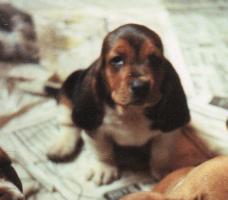
One little girl hung back. She was the runt, a watcher, a wait-and-see-er. My parents told her breeder that they wanted to sweetest, most docile little girl in the litter. A few weeks later, we came back to take her home. Our puppy had a ribbon around her neck. She was eight weeks old, all feet and ears. “Good-bye, sweetie,” the breeder’s wife said, sitting with her on the living room carpet. “Have a good life.”

Her first name was Nora, after Nora Barnacle, beloved of James Joyce. Her middle name was Helen—after Helen of Troy, of course.

*

Abandoned there, and half destroyed with flies,
old Argos lay. But when he knew he heard
Odysseus’ voice nearby, he did his best
to wag his tail, nose down, with flattened ears,
having no strength to move nearer his master.

—Homer, The Odyssey (translated by Robert Fitzgerald)

*

Homecoming is sacred to me, or near enough. I think Homer did that, unless it was in me all along. The stories that hit me hardest are those about coming home, or not being able to.

The worst grief I’ve ever experienced—prolonged, profound, unshakeable grief—has come to me twice. The first was when Nora died, an event that struck us very quickly and lasted long after she was gone. The second was the long, slow process of emptying out and giving up my childhood home.

The homecoming is sacred for me. Unless there is a very good reason for exile—unless I have agreed to hear a story about exile—I need for characters to be able to come home.

*

Not to derail this argument I’m building, but let’s not get too lofty. Dogs are a huge pain in the ass. They need walking, feeding, policing, cleaning up after, bathing, entertaining, quieting down. They stink. They shed. They fart. They get sick. They break things. They chew. They bark. They howl. They eat poop. They roll in carcasses. They slobber. They can bite. They destroy our living spaces. They defecate and urinate indoors, sometimes strategically. They swallow objects and ingest foods they shouldn’t. They track mud all over the floor and the carpet. They ruin furniture. They hump legs. They won’t leave you alone. They hog the bed or the couch or the blanket. They run away. They jump up on you. They get erections at bad times. They keep you home when you’d rather go out. They get neurotic and territorial. They might bully or herd or fight other pets or children. They lie and sneak and steal. They have terrible breath. They ravage your savings with trips to the vet. They have no boundaries.

But they’re also perfect. No one who loves or has loved dogs would disagree. We would do anything for them that we could.

*

Even people who know better can fail to give dogs credit. They somehow think that a dog forgets someone if they’re gone for a long time. This has always struck me as ridiculous. Whenever, at a reunion, someone exclaims, “He remembers you!”, I have to bite back a snarky retort.

Watch this video. Maybe you’ve seen it before: the compilations of dogs welcoming soldiers back always seem to come around. But this one gets me. It’s not a flashy reunion, not like the gigantic Great Dane with his paws on his owner’s shoulders, or the duo of raucous baying beagles, or the small white Westie, vibrating with delight, hoisted high and close in her master’s arms.

This is an old dog. Look at the white in her face. Listen to her. Watch her see her owner again. Ignore the family member who laughs about how she remembers her soldier.

Listen to her. Recognize that? She’s weeping with joy.

*

Except for Argos, the loyal hound who died after waiting for Odysseus, Homer doesn’t generally like dogs. In the Iliad, they’re scavengers of the dead, the lowest of the low, to be cursed and chased away and railed against as they eat the fallen. In the Odyssey, Odysseus laments that his belly makes him little more than a dog, an endlessly hungry body that drowns out the intellect and keeps man from godliness.

Nora was always hungry. She was greedy, and she schemed. I have more stories than I can count of food (and non-food) that she stole, often with ridiculous consequences. (Bags of doughnuts, whole pizzas, an entire gingerbread house, high blood pressure medicine, a cabbage which got stuck in her teeth, endless boxes of crayons…)

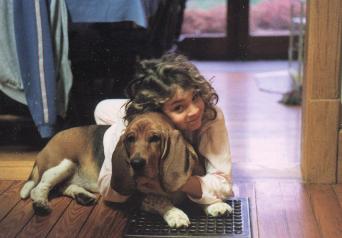
About a year after we got Nora, we went on our very first cruise. It was only a week or so, but it was an eternity to a kid who has finally gotten a dog. Mom stepped in: she began to tell me stories about what Nora was getting up to while we were away. Often this involved breaking out of the kennel, donning a special S.W.A.T. suit, tracking me down and embroiling me in a caper that spun wildly, hilariously out of control. My mother’s Nora stories were my favorite thing in the world, and I begged her for them long after I supposedly outgrew them. They also made me determined to be a storyteller.

As you can see, being 7 and 8 was a pretty big time for me.
*

I’m writing this because someone asked me to. “Why dogs?” she said. “Why not cats or rabbits or birds or snakes?” For me, dogs have been all I’ve ever wanted. For her, there was nothing instinctual about wanting companionship from a dog, which is fair.

Why dogs?

I spent a lot of time turning this question over. For days, I sifted through heaps of cliches. Dogs are honest! Dogs are good to hug! Dogs are hilarious! These are true things, but they weren’t the answer I wanted to give.

Something about how dogs emote gets me where I live, that’s true. Canine emotions are easy and satisfying to me. When they’re joyous, it’s in their whole body, their eyes, their voice. When they’re upset, you know—they linger or pace or tuck their tails between their legs. Dogs make no beef about what they want: they’ll bark at the place you keep the leash rather than be coy.

Watch a dog run sometime—really watch, especially in a large, open space. Maybe in slow motion, if that helps. Look at their faces, look at the shapes their bodies make. Look at the length of ground they cover. Do you find that kind of happiness enviable? I do.

That was another answer: I like the way dogs interact with space. I like the way they’re built, the way they move. I like them aesthetically. I prefer big dogs to small dogs. I’m tall, and always have been; I like how unapologetically big the big dogs are. I like how gentle and sweet they are too.

I like them when they’re loud, when they throw their weight around, when you can hear them coming. I like their presence. I like them when they’re graceful and when they’re ungainly. I like the way they sprawl, and the way they curl up with you. I like the way their faces move, how openly they show what they feel.

I like the big dogs who think they’re lap dogs. Ever had a Great Pyrenees sit in your lap? I did. His name was Mister, and it was like being cuddled by a cloud.

*

The last time I saw Nora was the day I left for my final year of college. I’d come home every summer, in part to be with her, but now my boxes were packed and she needed to go to the kennel. She was old then, nearly 14, and most of her fur had gone white or faded. She sat on the porch, watching me load the other car.

I wasn’t going to the kennel. I don’t remember why; I think I still had packing to do. She always knew when I was leaving; she was no dummy, and she always got clingy and sad. I found her hiding in some bushes. I remember how bright the sun was, and how ghostly she came out in the pictures I took. I laughed at her, untangled the leash and coaxed her back up to the porch.

Looking back, I do think she knew this would be the last time, that she wouldn’t see me come back. I leaned down, very easy, and kissed her in my favorite spot, right between her eyes. How was I to know? She was old, but not so old, and in perfectly good health then, for the most part.

Nora declined, sharply, at the end of October 2005. My parents drove her back and forth to a pet hospital in Columbus, eighty miles each way. We all hoped, desperately, that she’d pull through, just a little while longer. She came home from the hospital the weekend before Thanksgiving. Her kidneys were failing, and she had a tumor in her pituitary gland, and she didn’t seem to recognize people anymore. My parents wrapped her in blankets and put her out on the porch, where she sat in the sun for a while and seemed happy.

The day before I flew home, I shot up in my bed at 6 AM, not knowing why. Right then, though I couldn’t have known it, my parents came downstairs and found her, still warm.

I’d never cried like that before. For months, I dreamed about her. It was incredible, staggering grief. Not long after, I was talking to my mom about it, trying to comprehend it. “Well,” she said, “I guess love makes you ready to love more.”

*

All dogs are different. Not all dogs are good, or giving. Not all owners relate to dogs the same way. But this is about why I love dogs, and the dogs I’ve loved have never held back.

*

Gus came to us after almost a year without Nora. We drove to Toledo to get him. Even at five months old, his feet were as big as my fists. I was conflicted about welcoming him. He was another dog, and we needed a dog in our lives, but he wasn’t Nora. He was a very different creature: well-behaved, and simple, as boy dogs tend to be. But he slept between my legs on the long drive to his new home, and he sat in my lap and he huddled against me, scared but trusting.

He grew into the dog-space Nora left behind, in his own way. Now he’s almost six, and a whopping 80 pounds. Every time I come home, we go through the same routine: I drop to the floor while he charges into the kitchen and throws himself at me. He stands on my knee and chews on my right ear. Then he settles into my lap, for hugs and wrestling and bellyrubs.

My mom was right about love. That’s not exclusive to dogs, of course, but for me, at least, they paved the way.

*

My favorite part about coming back from college was getting in late at night. Often I would take evening flights, and after the two-hour trip from the airport, we’d pull in to our driveway, quietly. We’d come in to the dark house, still quiet, and I would set my bag down near the door.

Nora liked a particular corner, a little nook between the living room and the kitchen. She curled up in a perfect doughnut, feet tucked beneath her nose, snoring and dreaming. Before we turned on the lights, before we made any noise at all, I’d crouch by her head and wait. Before she woke up, her tail would begin thumping. She smelled me. When she opened her eyes, a visible shock of happiness went through her body. She stretched, sleepy-excited-content, and twisted toward me, and her tail would wag harder. That’s when I’d kneel down and kiss her nose, and the spot between her eyes, and scratch behind her ears while she sighed.

This is one way of saying why I love dogs. The homecoming is sacred to me, or near enough.

*

We’re near the end,

but O before the end, as the sparrows wing
each night to their secret nests in the elm’s green dome
O let the last bus bring

love to lover, let the starveling
dog turn the corner and lope suddenly
miraculously, down its own street, home.

—Katha Pollitt, “Small Comfort”

Regarding delays

I’ve alluded, on and off, to outside stresses that are keeping me from updating as regularly as I’d like. It’s gotten to the point where it makes less sense to avoid talking about what’s going on. So, here it is.

My mom has been dealing with brain cancer (glioblastomas) for about four years now. In November, she had a clean bill of health, but this past Monday, another MRI indicated that tumors are growing again. The physician who’s been in charge of her treatment since her diagnosis says that this is now an end-of-life conversation, and that she may have anywhere from two to six months to live.

My family is not giving up hope; there are several discussions now about second opinions and other options, including the possibility of seeking treatment at cancer centers out of state. Right now we are working to give her the best treatment and support that we can. I have tickets to fly home on Friday, but plans are still shifting.

This is the nightmare scenario, and it’s scary and it’s awful beyond words, but I can say this: the love and support of the people around us are overwhelming, and incredibly appreciated. It’s humbling. Thank you. Many times over, thank you.

What will this mean for Innogen and the Hungry Half? I don’t know yet. It may be that I work on it all the harder in order to have some way to be away from all this; it may be that I can’t focus at all, and Magpie & Whale becomes more nonfiction for a while. My intention is to try for the former, and the goal is still to finish the story by April, as the outline dictates. Readers, you have been so supportive and so patient and so encouraging; when so much else is going to pot, I absolutely appreciate that kindness and enthusiasm.

So, that’s that. I suspect I’ll be writing about it again as we go forward, but I just wanted to stop being oblique. This is no longer something I can keep separate. Thanks again for sticking around.

Best,
Esther

Love in the time of science

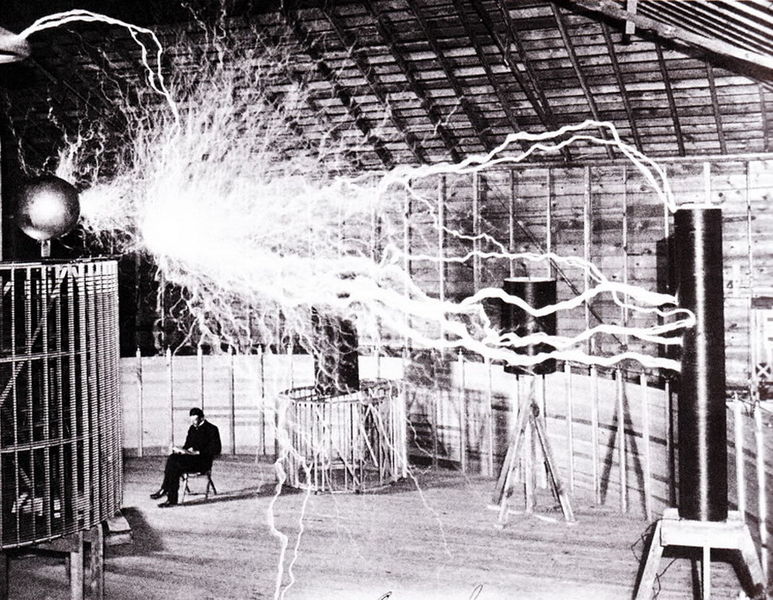
Nikola Tesla testing Tesla coil indoors

First things first, folks: I have every hope of posting Chapter 8 of Innogen and the Hungry Half this Tuesday. I am proceeding with this post as though that will be the case. There’s some personal stuff happening at the moment, though, and we expect to get some important news over the next day or two. If there’s another delay, it will be because I’m dealing with family things. As ever, I deeply appreciate your patience and support.

I have been having some frankly wonderful conversations lately with the fabulous Alexandra Kingsley, who is always doing a lot of really cool things with literature, theater, the BBC Sherlock and Americana. (Everything she does is excellent, so you should check out her work!) She told me that she enjoys reviewing these preview posts after the next chapter goes up and seeing what hints link up to the story. Does anyone else do that? I really enjoy writing these up, so it’s lovely to hear you all are enjoying them too.

Fun fact, as an aside: Nikola Tesla shares a birthday with me, along with Jessica Simpson, John Calvin, Marcel Proust and the State of Wyoming.

In The heavens must still work, Imogen wakes up to find the world has changed around her while she slept. She goes to confront the source of all this upheaval, but what Rigantona has to say shocks her. What’s coming? How will it all unfold? Read on and see what you think!

One song:

“Haunted” by Poe [lyrics]

Ah, Poe. So great for so many reasons. This song and this album in particular have a lot of Shakespeare in them: Poe has threaded Hamlet throughout the album’s narrative, and here, bits of King Lear (“My heart will break before I cry”). I’m also delighted, now that I’ve read the lyrics, to discover that one line is “Hallways, always.” Right fitting all around.

Two links:

Rigantona’s device is not quite a Tesla coil, though they’re certainly closely related. One great thing about writing steampunk technology is you can play fast and loose with your skience, so long as you keep it believable/consistent. I do this with open eyes and hope my readers do too. However, this guy who works at the Griffith Observatory in Los Angeles (which you may recognize from Rebel Without a Cause) gives a great five-minute explanation of what a Tesla coil is really capable of, aside from emitting really cool, gigantic sparks.

And who knows how accurate this is, considering it’s from Tumblr, randomly, but I enjoyed this factoid about children and the age of most nightmares. Considering what’s coming, you may too.

Three lines:

Do you feel me right here? She pressed him to her shoulder as he gasped himself back to sleep. It was a problem to be worked out in the dark, the thin weight of him huddled against her side.

Big things are coming. Are you ready? New, game-changing chapter this Tuesday! As always, no knowledge of steampunk or Cymbeline is necessary to enjoy Innogen and the Hungry Half, but if you’d like to read the play, MIT has the full text available for free online.

Innogen and the Hungry Half: 07 – The heavens must still work

Fractured reflection of old clock face

Previously: Out after bedtime; Sower Street; a ringing endorsement; pub crawling in the Roman Empire; he’s not his brother; haven’t I seen you before?; katabasis; corralling Cloten; a convenient exit; a confession; a convenient pipe; a confirmation.

That isn’t my perfume.

It colors everything—the smell of my sheets, the smoke in my hair, the stink of Sower Street still in my clothes. A newspaper rustles. Before the sound ends, I am rigid and upright in my bed.

“Calm down, my dove. Helen let me in.” Varinia doesn’t look up from her broadsheet. She fits precisely into my chair, ankles crossed. She has come in her traveling clothes, the long, tailored jacket spilling over the seat.

I yank my quilt up to my waist. “How long have you been here?”

“You obviously needed your rest.” She eyes me around the page—the Citizen Countryman, out of Durocortorum. The headlines swim. “I took the liberty of having your letters sent out.” She makes a show of folding the paper, the creases correct, just so. “What an exciting evening you had. Was he worth it?”

“You are completely out of line.” I fling back the covers, willing my panic not to show so drastically, and bolt for the nearest dressing gown, slung over a closet door.

“Your hair is so long now.” She’s smiling at me. I can hear it. “I can’t remember the last time I saw it down.”

My hands shake as I tie off the robe. “Can you remember when last you saw fit to trespass on my chambers?”

Her chair creaks; she’s leaning back. “I’m leaving Britain soon. I’ve missed you.”

Helen let her in. Dorothy didn’t wake me up. In my own bedroom, of all places. I face her, fists balled at my sides. “Is this one of the rights of a quaestor of Rome? To presume you understand how I weight my schedule?”

“Have you been seeing to business, then? I should love to hear of it; my work has been lacking in trifles these days.” Her voice goes harder. “I cannot imagine what outweighs the future of your own nation, but then, I am not so young as you are.”

My knuckles go white. “Do not insult me for my age. You never have before.”

“And you have always kept your appointments. But then, you are very like your father.” Some of that languid drawl seeps back into her voice. Cold shots hurtle up and down my spine. “I worry, Imogen, that I am telling you this, rather than the reverse.” She reaches into her jacket and offers me a piece of folded paper—treasury letterhead. “This came across my desk last night. Look and see what your father has authorized.”

The memo is short and formulaic. By order of Cymbeline, Rex Britannicus, funds heretofore allocated to the below subsidies and works are hereby redirected to defense.

Increases in military spending. Illyria took steps long before they broke the Pax. My cheeks color. “You know he’s negotiating to expand the Roman rails. As a show of good faith—”

“Imogen.” Varinia rises. Her silence demands my full attention. “Rigantona’s been spending time here. We know what she’s like, and what she believes.”

I wait to hear it, proprietary technology, the good of the empire, where is ours, but Varinia only crooks an eyebrow. “It is easy enough to start a war from a pillow,” she says, more carefully.

I breathe in, once, and hold out the memo with a small smile. “Virginity doesn’t make me stupid.” We must be friends, Varinia and I. She is too valuable to be otherwise.

She shakes her head. “I have copies. Do not let your father deny it.” She hooks her buttons through each hole, one by one. “I have every confidence in you, my swan. Trust me when I say this visit was a compliment.”

We embrace, and I inhale her perfume. “All the same,” I say, in the moment before we let go, “when you come back to Britain…”

“In the spring, I hope.”

I set my hands on her elbows. “Never come into my bedroom like that again.”

“If you invited me, I could never accept.” She winks, and kisses my cheek. “I’ll be in Lusitania for a month, then winter in Cyrenaica.” Her lips curl at the corners. “I’m only a telegram away. Please send word if you’re in danger of marrying Rigantona’s son.”

I clutch my stomach. “You would never say such a thing if you had met him.”

Helen is pacing outside my door, hugging one elbow, a knuckle to her lips. She snaps to attention, anxious, but I dispatch her and Varinia both with coolness and poise. Varinia glances at me over her shoulder; I shut the door and sink against it.

The room looks different to me, now that someone has intruded on it. Dorothy declined to wake me up. Helen chose to let Varinia in. I cannot be showing that much strain. I cannot require tending.

No one who knows this business could accuse me of being idle. Even so, I have been stalling; nothing else can rightly call itself preparation. In the quiet, I slip out of my dressing gown and shuck off last night’s disguise. No more skirting the matter. I must arm myself.

*

Dorothy pins my damp and scented hair, not at all hiding that she’s watching me in the mirror. I hold myself straight and still, looking over my vanity. The tabletop is a clutter of bottles, tins and notes, but only we will ever know that. I will look my part today: she will appreciate that. The dress of a local, highly regarded make; the necklace from Sorviodunum, Rigantona’s birthplace; the glass comb in peacock colors, a gift from Neapolis, shot through with gold teeth.

“I am only saying—” Dorothy begins.

My eyes flick up. “We are done with this.”

She adjusts a roll of hair. “It’s not that you’ve been straying, it’s that for you, all this—”

“I’m not a child, Dorothy. It’s not your place to mind me like this—”

“—you’re leaping out of a hot air balloon.” For a moment, we glare at each other’s reflections. Dorothy thins her lips. “You’re never like this, Imogen. You’ve always been so good.”

Lies have their uses, but the truth accomplishes more. I look away. “On the contrary, I think I am more myself than ever.”

The door swings inward; Helen approaches my chair, too quiet, her usual bundle of letters and papers in hand.

I break the silence, as is my right. “You are in a king’s house, Helen.”

Helen does not waver. “She thanked us for your father’s hospitality.” She sets the letters atop a jewelry box. “She mentioned the Boar and Brachet, and said you would know what that means. I am to ask after its local charm.”

I must exhale. “It has little.” Varinia did not press on the matter of Cloten; another front may have opened up, but I suspect she’s showing her hand to make a point. If the world knows the British princess came to Sower Street, it will have come from her. I look back to Helen. “Where is the king this morning?”

Helen raises her eyebrows. “With chieftains from the Cornovii and the Atrebates, touring sites for the Roman rails. He’ll be out of Londinium for several days.”

Dorothy sets the final pin in my hair. She holds up a hand mirror so I may inspect the back. A moment’s study, and then I look to Helen. “If he writes, tell him all is well.”

She remains stiff-backed. “Lie to him?”

I rise, and gather up the letters she brought. She will see my face as I speak. “There is no lie in it.”

*

Only the din of construction troubles the halls, muffled, intermittent and somewhere out of sight. Someone must have told me that my father would be gone. I must have known, though I cannot call one scenario less worrisome than another. The full contingent of guards remains at the palace; they patrol the corridors, vigilant of the royal person as ever. Some stand square-jawed and ceremonial, but others nod and wink as I pass.

As a little girl, I honed many of my charms on the palace guard. I was reprimanded more than once for distracting them from their work. I argued that they would protect a friend better than an assignment. My father always growled that duty was impetus enough.

Rigantona’s work crew greets me with an atlas of accents: Durotriges, Brigantes, Iceni, one thick burr I suspect is Caledonian. One shows me how they’re threading the wires through the walls without damaging the woodwork. A low hum laps at the edge of my hearing. The Caledonian engineer assures me it’s just the generator stowed in a wall nearby. There are more of them every several yards. It’ll subsume, he says. I won’t notice it after a bit.

The unmarked door is three halls away, with no guard in sight. More than Varinia’s cautions, Cloten’s words last night have wormed their way into me. I cannot begrudge my father some dalliances. It has been a long time since my mother died. I will focus on this, on arming myself. I will push past what happened on Sower Street: Cloten’s fumbling hands, his sour breath, his plaintive, abusive self-pity.

This is the usual room. It looks onto a secluded cul-de-sac; in the spring and summer, it smells of mint and the flowering trees below. A place for lingering. The bed is crisply made, the linens sweet and fresh. Greenhouse flowers sit on a table, the water high in the vase. There is no more reason to stay here. I know enough.

My father sets his favorites outside this door. When I step into the hallway, I don’t recognize the guard with whom I nearly collide. The guard has a young face atop a broad body. I blink at him. “This is Dagobiti’s post.”

The stranger gestures with his pike at the hallway. “I’m filling in for him, milady.”

Dagobiti has always showed promise—strapping, popular, discreet. When I was younger, I nursed a bit of heartache that our love could never be. I wonder who this new boy is, and what he has done to merit guarding Cymbeline’s lovers. I search his face. “Is he with the king?”

He is too professional to shrug, but he wants to. “I wasn’t informed,” he says, “just told to be here.”

I cannot begrudge him. There is value in being where you should be.

*

I glance at Dr. Cornelius’s back. “Are you sure he doesn’t mind?”

Posthumus snorts. “Only one thing makes him happier than being arm-deep in starfish, and that’s cutting live starfish in half.”

“Is that what you do here?”

“It’s not that barbaric,” he insists. “They grow back. He’s studying how they regenerate.”

Dr. Cornelius coaxes and cajoles his quarry from the side of a barrel. My insides twist on themselves a little. I turn back to Posthumus. He stoops to avoid the hanging lamps; the yellow cast of the light brings out the bruises under his eyes. “Pisanio knows,” he says quietly, before I can explain myself. “We spent most of the night talking about it.”

A particular spot in my chest clenches. I would have trusted Dorothy that much, before this morning. “What did he say?”

“That I was always an easy boy to raise, and that he can’t speak for raising any other.” A shadow deepens at the corner of his mouth, but his shoulders are tight. “It came out, though, that I changed when I was eight.” He bows his head. “He just thought I was living up to my potential.”

I hug my elbows. “You believe it happened, then.”

“I see no other explanation.” He pulls at his rubber gloves. “It makes no sense not to move on.”

He wrestles with it, though. Every inch of him broadcasts his struggle. I don’t know why it troubles me less, to think that he has been distilled into his best parts. Then, that is our nature, his and mine. Posthumus is the good half. I have seen it all my life. So be it if that is the consequence of our actions that night, even if Cloten is the byproduct.

(I must still make myself pity Cloten. A better person would have done so already. Who would leave anyone passed out and injured in an alley? But I am coming to accept that as well.)

“You’re dressed very nicely,” Posthumus says, when neither of us have continued. “Are you going to see her?”

I push my shoulders back. “Yes.”

“I ought to come,” he says, but makes no move to remove his gear.

I hesitate. “How did Pisanio manage when you told him?”

“Not well. He thinks it’s mad. But he’s not running from it.” Posthumus watches Dr. Cornelius. The frames of his glasses glint briefly. “It’s a lot to take in.”

“Aha!” Dr. Cornelius raises his arms and beams. “There—the work of many months! Pure science, my lady. Your father won’t be sorry!” I peer at the specimen he displays for us, spread out in his hands. His quarry is a misshapen creature, with one large arm and a number of odd-sized others. My stomach lurches. I imagine it has been cut many times over.

“Is that the original?” I am too aware of Posthumus just at my shoulder.

Dr. Cornelius’s smile falters. “Eh?

“When you cut them—” I nod at the starfish. “Is one the original and the other the twin?”

“No,” says Posthumus, a tray in hand. He steps past me, heading for the scalpels. “No, there’s no original.” He begins picking out his instruments. I can’t see his face. “They both are.”

*

Tincomarus Place is no place for a revolutionary. The houses are uniform and fine, with pristine faces and good bones. Of course, Rigantona, clarissima femina, is not afraid of tools, any more than I am afraid of armor.

I look at what she’s telling me from the sitting room where I wait. She has only been renting the property for a matter of weeks, but she has filled it with books—interesting ones, from what I can see, touching on all number of subjects. Every available surface is covered, with papers, letters, bits of machinery, a stained teacup and saucer, whatever is at hand. I imagine the housekeeper’s orders are the same as ours: do not move a thing, I know exactly where everything is. The knot in my chest eases, if briefly, and irrationally: she is just as messy as I am.

I remember how it is now, to be nervous about meetings. Varinia always said that was the side effect of perceiving a power imbalance. Rigantona is a scientist, and I am heir to the throne. This is not a matter of power.

I focus on my breathing, in and out, deeper and slower, until the room slows down. I cannot ask this question yet, not even in front of Posthumus. I must prepare myself.

Heavy footsteps outside, descending a staircase. The noise jolts me out of my calm. My mind sprints from one unlikely possibility to another. I strain to see through the open door.

Cloten staggers past, bleary-eyed and grubby. Straight lines are beyond him: he blunders against a wall with a soft thump. I’m on my feet before I can reconsider, watching him from the next door down. He catches sight of me. I grind my teeth, bracing for some assault, but he simply grunts, sighs and continues. No memory of the alley, then. No memory that we found him, or that we came for him. He slouches away, trailing the tie of his bathrobe.

I have no more hope of quiet; now I can hear all the noises of the house. Pipes rumbling, shoes clacking, door shutting. I straighten. Two voices, coming closer through the corridor. One is Rigantona’s; the other is male, and familiar.

I peer down the hall. She is striding alongside a palace guard, one who is out of uniform but unmistakable. I have become uncareful about watching. Dagobiti spots me and slows to a halt. “My lady?”

Rigantona steps forward, lit up with a smile. “My dear Lady Imogen, what a surprise!”

“Good morning to you both.” There can be no more preparation. I hold my chin up and look to Dagobiti. “My apologies, I didn’t expect to find you here.”

He grins. “The king has asked me to supervise the new security system. Rigantona was putting me through my paces to be sure I’m up to it.”

“He more than is.” She sets a friendly hand on his shoulder. “I hope you’ll forgive me if I turn my attentions to the princess.”

“Not at all, ma’am!” Dagobiti shakes Rigantona’s hand, then offers me a crisp parting bow. “My lady.”

The house has gone quiet to me again. Rigantona leads us back into the sitting room. “I’m so pleased you dropped in, my lady.” She catches my eye and smiles. “I was about to order lunch. Would you do me the pleasure of joining me?”

“I suspect you may wish to hear me out before that.” I fold my gloved hands. Here it begins. “I’ve come on a matter that’s personal to both of us.”

Something canny comes over her face. She offers me a seat, which I accept; she pauses, to remove her jacket. “I beg your pardon, my lady. If we may both make ourselves comfortable…”

The sleeves of her shirt are rolled to the elbow. Her forearms teem with tattoos; more are surely hidden beneath her clothes. Rigantona gives me a wry smile. “The markings of a different age. I assure you they were quite fashionable at the time.”

The ink is bright and crisp: she maintains them. They’re also all of a type: horses, trees, slogans, fish, whorls. All the iconography of British nationalism. She lowers herself slowly to her seat.

“A personal matter, then. My dear, I believe I can guess.” She presses her palms together and touches the tip of her mouth. “It’s your Posthumus. He’s the other one.”

There it is. And still my preparations fail me. “My—sorry?”

“Posthumus. Your friend. Or… more than that?” She lifts her eyebrows.

“He’s a dear friend,” I say quickly.

She lowers her hands and nods. “I knew as soon as I saw him. I didn’t wish to proceed indelicately, though. Imagine my shock—of all people, the daughter of the king.”

I prop my hands against my knees, though every inch of me must be shaking. “We must trade stories, then. I owe you an explanation, and much more.”

“Yes,” Rigantona says, and threads her fingers. “Such a long time we’ve been half in the dark. Shall you go first, Lady Imogen, or should I?”

home | next: How fit his garments serve me

Hi, and thanks for reading! Got some feelings? I would love to hear your thoughts. All content © Esther Bergdahl, 2011. Thanks again, and hope you enjoy!

The White Rabbit is my spirit animal

At some point early on in the process of writing Innogen and the Hungry Half, I made an attempt at devising an ideal and reasonable production schedule, one that would more or less keep my usual stressors at bay. It’s so sensible, I’m amazed it came to me at all. The schedule looks like this:

Tuesday: Having published a chapter at 9 a.m., I may spend the day alerting readers of the update and taking notes to outline the next chapter.

Tuesday evening, Wednesday and Thursday: Write 1,000 words each day for a first draft. Each chapter tends to be about 3200 words, more or less. During this time I also bother Excellent Enabler with sections as they come, and she tells me what she likes and what could use improving.

Friday: After polishing the first pass, I then send the draft to First Beta, who gives incredibly helpful notes about structure, characterization, plot holes and other big picture issues.

Saturday: I write that week’s chapter preview, which I then schedule to post automatically sometime Sunday morning.

Saturday night or Sunday morning: I edit according to First Beta’s notes, and send the revised draft to Second Beta, who tackles word-by-word issues, smoothing out unclear passages, typos and other messy writing bits.

Monday evening: I edit the chapter with Second Beta’s notes, and schedule the post to go up the next morning. Then I kick back and congratulate myself for managing my time and resources so well.

Sadly, this has yet to actually happen: the real process involves a lot more procrastinating, obsessive outlining, endless and obscure note-taking and scrambling to make deadlines. Things are always finished much closer to posting than is comfortable. Weirdly, though, I like it, and miraculously, so do my friends, for which I am very, very grateful. And each week is an opportunity to get better! This entry is dedicated to anyone who has ever received a frantic last-minute email from me promising that this is the last time this will happen.

Last time, Imogen and Posthumus had a night on the town that anyone would want to sleep off somewhere private. Too bad that’s never an option when you’re the daughter of the king. What’s waiting for them on the other side of the alarm clock? Check back Tuesday to find out — for now, some hints and clues!

One song

“The White Queen Sleeps/The White Palace,” Iain Ballamy, Mirrormask

Do yourself a favor and see this movie if you can; it’s not actually as dated as this trailer makes it look. Imogen is going to wake up in a world that’s askew. This track unnerves me every time I hear it; it’s just off and just eerie enough.

Two links

Tattoos fascinate me, especially when they pop up in seemingly unlikely settings. A Brief History of Tattooed Ladies also piqued my interest.

I’m also not going to deny that there’s any of Hedy Lamarr in Rigantona; it’s too neat a fit.

Three lines

I see the corner of his mouth quirk, but his shoulders are tight. “It came out, though, that I changed when I was eight. He just thought I was living up to my potential.”

All right, we’re off to the races now. Come back on Tuesday to see how it falls together! As always, no knowledge of steampunk or Cymbeline is necessary to enjoy Innogen and the Hungry Half, but if you’d like to read the play, MIT has the full text available for free online.

Older than I’ve ever been

Question mark on train wheel

One of my very dearest friends is in Chicago for a quarter, doing wonderful and enviable things at our alma mater. We met up yesterday and instantly started rambling about all the writing projects we have in the air. Being able to talk about story and craft and influences and all the tricksy bits of writing is one of the many reasons I’m so deeply happy she’s here. I began telling her about the series (!!) I want to start (“You want to write not-urban urban fantasy!”), and she told me all about her plans to submit short fiction to paying markets.

“Where does one find out about that?” I asked. “Because all these people I know find out about all these neat anthologies, and I can’t ever seem to keep on top of it!”

“Duotrope,” she said, and I said, “Ooooooh.”

I bookmarked Duotrope once upon a time, but it was buried in a browser I hardly use anymore, and being concerned with other stages of my writing career, I forgot about it. Now, of course, I’m getting that feeling: this is the year. This is when I’m going to buck up and start submitting. This is when I’m going to see my name in print, so to speak. I’ve got all sorts of plans and ideas, and I feel terrifically energized, especially now that Innogen and the Hungry Half is approaching the “one-third of the story” mark, which I honestly kind of never thought would happen. (New chapter this Tuesday, by the way! My computer seems to not be dying yet, thank goodness, and if it does, I’ve wised up and have my external hard drive to save me.)

At the beginnings and ends of calendar years, we often wind up taking stock and making plans. I’m generally less good at the latter, but I found my most recent bout of the former yielded some pretty good results. As it happens, today is the one-year anniversary of my first post to Magpie & Whale. It’s basically a filler entry–it even retains the “Hello world!” subject line–but it’s amazing how far this site has come since then.

We’re also nearing my half-birthday (five more days!), and being 27 and a half gives me a good deal of thoughts. This past birthday, I started to feel like it was time to get my life together in a more directed way. About a year ago, I made up a list of things I wanted to do before I was 50 (see July 10, 2034); I’m actually able to cross some of those off today, to my great delight. I know what I want to do for graduate study, and I know where I want my career to take me, which is farther along than I’ve ever been before. (I’ve also got some big trips and excursions planned: stay tuned for the fun times as well!)

I’m so proud of the work of the past year, and particularly of the past several months. Thank you, all of you, who have read and commented on and shared this project. Thank you to my wonderful friends, who have made this conversation so quality and so interesting. Thank you to my family, who stays interested and cheers me on. I think 2012 is going to be a good one. Much love, and let’s make it come true.

The joy of technical difficulties

Hey gang! It wouldn’t be Christmas without some kind of computer scare, and this one involves me scrambling against the event that my laptop might fry itself at any given moment. I’m off to buy some external hard drives (I know, I know), but given that these are unforeseen circumstances, please assume that, unfortunately, there’s going to be another delay on Innogen.

Thank you so much for your patience, and I hope everyone’s having a fantastic holiday season!

Innogen and the Hungry Half: 06 – A tail more perilous than the head

Previously: Britannicus the pamphleteer; Imogen the diplomat; Cymbeline versus Illyria; Cymbeline versus Innogen; Dr. Cornelius and his caller; Posthumus and the walls; Rigantona looks fondly on him; Imogen leaves on her own.

All of Londinium is my city, even the parts I haven’t seen yet. Behind us is the palace, the chieftains, the minders, the arrangements, the backrooms. Behind us is my father, whose greatest fear is that I will be out of bed.

We have the river between us now. Yes, it warms me a little. Maybe some. Maybe more.

This is my city, day and night. It will open to us if we ask.

*

“I say, I say, I say! A girl for that other arm, my lad? Fine-looking woman, two’s better than one, I say!”

Posthumus pulls me closer, stammering to the stout man who’s planted himself in our way. The fellow winks at me and tips his cap. “Or I got boys—you want two boys for your lovely lady there? Guarantee she’ll love it, bet you will too! Ten pieces for the first hour, prices negotiable after that.”

“I—thank you,” Posthumus tries, pushing up his glasses. A towering woman jostles us with an enormous, ragged bustle as she passes. I clutch my jacket as I catch myself, to be sure of my purse inside.

“We’re fine,” I say quickly, and lead Posthumus around the pander.

“It’s Bellicia’s Bawds when you change your mind!” he shouts after us.

Before I came to Sower Street, I might only have known this: that when the Romans built their great bridges over the Tamesis, fishers sold their bankside land to builders and moved on from fishing. That taverns, theaters and all manner of low entertainment bought deeds along the new road, and flourished like so many toadstools. That Sower Street is a byword in Britain for all the trappings of ill-spent money and youth.

Posthumus twists to stare at the pander, gobsmacked at the offer we just fled. “This was a better idea at the palace,” he says.

I have to smile, only a little. “Oh come now. Cloten is here somewhere—what’s that, if not a ringing endorsement?” I nod toward the long row of public houses, Romans and Britons alike streaming through the open doors. “Which one looks most appealing?”

“I’m not him,” he says, irritated. “Don’t start with that.”

*

I have accepted the fundamental madness of our childhoods, for which I’ve been granted some narrative consistency. Posthumus may not remember it, but that means nothing. Soldiers may black out the pitch of battle; survivors of a sinking ship may blot out their time in the water. A trauma like ours could easily leave no trace. A child might touch a machine and become two children. A girl might dream of it for years and learn it was true.

Cloten might know what happened that night at the exhibition. He was there too, and his mother who found him had to tell him something. We are not doing anything unreasonable, now that this is the case.

*

The Emporion, the sprawling port. Every surface plated with bright tiles from Massilia. Continental fare covers the tables, wine and olives and goat’s cheese and rosemary. One look and I’m ready to turn around. “He’s not here.”

Posthumus knits his brow. “He might have stopped in.”

Rigantona surely raised him calling us Lud’s-town. She believes in Britain. This place seethes with empire.

Posthumus catches a trim, dark man in a spotless apron. “Excuse me,” he says, one hand on his arm. “I’m looking for someone, my height, no glasses, curly hair.” The server glares and pushes past us. Posthumus tries to follow. “His name is Cloten. Has he been by?”

The server curls his lip and leaves us behind. At the bar, a smartly-dressed man, his black hair slicked neatly back, smirks into his tumbler. I am exquisitely aware of my scuffed boots and seasons-old skirt, of Posthumus’s knobby wrists inches beneath the sleeves of his coat. This place is aspirational; he wants to be here, not Cloten. All at once, I’m embarrassed for him. I grip the back of a nearby chair. “We can do better than this.”

Posthumus’s expression curdles, just a little. “I’m listening.”

You live at the palace, I want to say. Instead, I nod to the tiles, to the statues of the gods. “Let’s start with places where he wouldn’t come just to pick a fight.”

“Fine.” He dips his chin. “By all means, we’ll do it your way.”

I drop my hand. “That’s not what I’m saying—”

“Aren’t we wasting time?” he says, and strides toward the door.

*

“Can we be clear on one thing?” Posthumus steps to avoid a puddle of effluvia, pressing us instead into a hooting gaggle of wealthy teenage boys. “I need to know why you’re out here with me.”

“We need to find Cloten. Were you not sure?” I squeeze my elbows to my side, narrowly dodging a young man with much to learn about sharing space. “Remember we both had the same idea and met in the middle.”

Posthumus shakes his head. “I want to find him and see what he’s about. As far as I can tell, you just want to win at something.”

I smile. He’s needling because he can, because he’s nervous. “What do I want to win here?”

“You don’t like it that no one thinks your theory is wonderful,” he says. “You don’t like it that I haven’t said I believe you.”

My smile becomes tighter. “I don’t like that you’re less committed than I expected.”

“Soft beds up here!” someone calls from an open window. “No fleas! Good rates!”

Posthumus bows his head. “You’re telling me that I’m half of some other person. Forgive me if I’d rather take some time on this.”

Rigantona is not waiting for any of us. I can only laugh; I am out of other rebuttals. “What time have we got?”

*

Ardu, named for the forest without roads. The walls teem with hunting gear and taxidermy; no subtlety nor chance of escape allowed. The barkeep glowers, a gladiator in a starched shirt. His bald head gleams; his mustache bristles, perfectly trimmed. His arms bulge as he wipes down a mug that engulfs his fist.

“He’s not my brother,” Posthumus insists. “I’m just looking for him.”

The barkeep eyes me suspiciously. I give him a bland, eager smile. He grunts. “Strangers have no business hearing about my customers.”

I have coin ready; it gleams against the counter between us. “We’re customers too. Doesn’t that make us friendly?”

He pockets the money with not a flicker of interest and strolls off to the taps. Posthumus drums his fingers, engrossed with the wall art. The din of the pub rushes in to fill the space. Behind us, a cluster of men howls in a parody of song. A few seats down, a red lady leans against a shabby man, her hair threaded with the ribbons of her trade. Where her hand is is anyone’s guess. Posthumus appears, with effort, not to notice.

The barkeep returns with two tankards, one laughably dainty, which he sets before me. He grunts at Posthumus. “Left here about an hour ago,” he says. “I wasn’t sorry to see the back of him.”

I lean over the counter. He can be no harder to crack than a proconsul. “You don’t have any idea where he could have gone?”

The barkeep’s monstrous mustache twitches, but Posthumus cedes the man’s attention to me. “He didn’t confide in me. I’d guess further down the street.” He says so with rueful disdain, as one who knows that he’s low but not that low.

“He’s not my brother,” Posthumus insists, setting down his mug. The barkeep watches him, unimpressed. Posthumus glances at me, wipes his mouth and drinks again.

*

Three Cambrians cheer as we leave Ardu. “Lovely catch!” crows a ruddy fellow with one dead tooth. Posthumus tightens his hold around my shoulders.

“They’ve obviously seen him!” I hiss. “Let’s go back!”

“There’s nothing obvious about it,” he says, eyes forward. “They’re just catcalling.”

“I could give a damn. We have to talk to them!” I squirm out from under his arm.

He throws up his hands. “Yes, of course we do, Imogen, because after all, it’s your idea, and your ideas are never wrong.”

I circle in front of him and glare. “Would you shout a little louder, please? I don’t think the whole street heard my name.”

He rolls his eyes. “Oh, calm down.”

Don’t, Posthumus.”

*

We cut across the current, across the street. On the curb, a young woman is bawling; another crouches next to her, rubbing her back. Drunks spill past us, laughing and baiting each other. We step to one side, not looking at each other, waiting for an opening. One of them catches sight of us. He’s a middle-aged man, shorter than I am, half bald with a merry face. He beams. “Here now. Haven’t I seen you before?”

“I think you’re mistaken,” says Posthumus, at the same time I say, “Him? Have you seen him?”

“No. No no no.” The man veers closer. “I know I’ve seen you before.” He wags a finger. My breath catches. “Down on Epaticcus Lane, eh? Here on your own time, then?” He reaches for my arm.

In an instant, Posthumus has stepped between us. He has a good eight inches on the man. I cannot think of Posthumus as ferocious, but in that moment, he is so still, I wonder what he might do.

“Too early for a fight, Mato.” One of his friends pounds his shoulder and pulls him back. Mato gives me one more merry wink before he’s swept off down the street.

“This is all a mistake,” Posthumus murmurs, neck bent.

“Let’s not catastrophize.” I slip my arm through his again. I also look behind us, watching Mato, weaving away.

*

The Boar and Brachet, wild pigs and hounds crowding every inch. Posthumus cocks his head. “Isn’t it the Gauls who are obsessed with boars?”

It’s an old place, all the wood dark and stained and smooth. The booths are pitted with nicks and dents, deeply gouged with graffiti. The names and boasts are all British; not a hint of Latin to be seen or heard. A proud place. For a princess of Britain under Rome, an oddly uncomfortable place.

Posthumus has gone still again. Of course he has: abruptly, there is Cloten, raising his glass to a group of regulars.

He is hard to watch. He goes from chair to chair, the dog wagging furiously and hoping for scraps. I still can’t reconcile the movements he makes with the face and the body he wears. His expression shifts constantly, often exaggerated, often unpleasant. I glance at Posthumus, who is so quiet I hope he will come up for air.

“We should get him,” I say quietly.

Posthumus looks at me, skeptical. “It’s noisy, it’s raucous, the night is young and so are we—what do you think you’re getting from him tonight?”

“He’ll talk to us,” I insist. “This is important.”

“Imogen, this theory of yours, I’m not even sure I believe you yet.” Posthumus slips his hands in his pockets and looks out over the bar. Then: “I’ll get him.”

“Why don’t we both—”

Posthumus shakes his head. He’s in earnest. I glance toward the bar again, uncomfortable. “You don’t like each other.”

He doesn’t look away. “Let me have this.”

Posthumus is here for a different reason than I am. If I am honest, I have no rebuttal.

He leaves me at a booth that hasn’t been cleared yet. I slide into the middle of the bench and try being patient. One hand starts tugging at the fingers of the other. The noise of Sower Street is starting to bear down on me. I jump at an unseen burst of laughter. At another table, a handful of sailors whistle at me. When I look up, one of them makes grotesque kissing faces; another waves me over. I swallow. Posthumus has left me alone with my city. Realizing I don’t feel safe here infuriates me.

The Greeks have a name for everything. In one word, they describe the act of descending into the underworld: katabaino. Perhaps tonight is making me heavy-handed. I think we’re at the rim of something we can’t see the bottom of.

The pit of my stomach boils, watching Posthumus’s slow collision course with his double. Cloten has shed his jacket and rolled his sleeves to the elbow, loose-limbed and gregarious; Posthumus is shabby and contained, pushing politely through the throng. I wonder, in that moment, precisely what parts of him went with Cloten when they split.

I brace myself for tension, more of the spitting cats from our encounter near the Pallas. Instead, Cloten beams and crows “Posthumus Leonatus!” before thumping him on the back. He embarks on a ramble, full of gesticulations. The regulars lose interest. Posthumus leans close to him, and then points toward me. Cloten’s face lights up with that leer. My jaw goes tight. He swipe his coat from a stool and marches toward the booth, Posthumus at his shoulder. I slide to the outside edge of the bench: he’ll have no chance for liberties.

Cloten plants both hands on the table in front of me. “Who’d have thought to see you here?” He grins. “You have any more surprises for me tonight?”

He reeks of curmi, the cheap barley liquor. Posthumus hovers behind him. To see them side-by-side is still dizzying. I lift my chin. “Have a seat.”

Cloten needs no further obliging; he throws himself down the bench. Posthumus lowers himself next to him, corralling him by the wall. I fold my hands. “Cloten, we’re so glad we found you.”

“Aren’t you?” He smirks, and slings an arm over the back of the booth. “I knew you couldn’t keep away from me.”

“That’s not what she’s saying,” Posthumus begins.

He reaches for his shirt buttons. “I was going to woo you first, but hell, if you’re eager, I’m willing—”

“Cloten,” I interrupt sharply. “This is important.”

He pounds the table. “By all means, then, another round!” He splays a hand over the table, then counts each finger. “I have been at this for five hours now. Let me elucidate you, it only gets better with more.”

*

Cloten plants his chin in his palm. “You came for me,” he says dreamily. “How many times?”

“Mind yourself,” says Posthumus sharply. “She’s going to be queen one day.”

Cloten wags his eyebrows, a senseless jackal just before he laughs.

“Enough.” I shift toward the edge of the bench. “Cloten, we have questions for you, personal questions. Let us take you somewhere, we can make sense of some things.”

“Why, what is it we can’t do here? Other than the expected. I’ve already been reprimanded for that.” He slings an elbow around Posthumus’s neck. “I feel so close to you already—”

“He’s not your brother!” I snap, unplanned and more passionately than intended.

Cloten wrinkles his nose. “Who’s saying that?” Posthumus watches me while carefully disentangling himself from Cloten’s arm. “You know, we both made mistakes tonight.” Cloten’s mouth twists, ugly. “You left your father with my mother, and I left my mother with your father.”

Posthumus frowns. “She’s working for the king.”

Cloten twists toward him. “Have you ever worked a queen?” He winks at me. “Or a future queen?” He claps a hand on Posthumus’s knee. “You should if you haven’t tried.”

My cheeks are hot. All my foolishness is smacking me in the face right now. Everything we’ve learned tonight could have waited another day. “Watch yourself, Cloten. You won’t remember this in the morning, but I will.”

“Save your breath,” he sneers. “This isn’t the palace. None of this matters and no one cares.”

“Listen,” says Posthumus quickly, glancing at me, then turning to Cloten. “Why not take a walk? Get some fresh air?”

Cloten points at him. “You have an interest in asking me nicely.”

“We both do,” he says. “Come on, there’s no reason we can’t all be friends.”

Cloten thumps both elbows on the table. “I like him,” he says to me. He sniffs. “So what if he’s poor and half Roman? I wish you could be more like him. Wait, this is a good one!” He hunches low. “Have you got any Roman in you?”

Posthumus sighs. “Don’t answer that.” He stands and buttons his jacket. The sailors start to howl and whistle.

“Are we going?” Cloten blinks. He waves lazily at the churning pub crowd. “Forget all this. I know a back way out. Forgive me if I’m not precise—I was distracted when the lady showed it to me.”

*

We’ve come only to make him trust us. We follow him, past the brewing vats, past the kitchens, out the delivery doors, into the alley and past the men urinating on the bricks. Posthumus and Cloten walk sometimes shoulder-to-shoulder, sometimes drifting into a line. The rhythm in their movements is nothing alike: Posthumus upright, steady; Cloten swaggering, meandering. How different they became. How queasy to see them together.

The alley runs parallel to the street—to be expected, but so far we can’t seem to find a way back, save through other pubs. I glance at Cloten, hoping he hasn’t led us totally astray. There’s something haggard in his face under the cider cast of the gaslamps. He’s coiled tight and in his cups, which makes me warier than ever. “Are we close?” I ask, hoping one or the other will answer.

Cloten stops and looks around, his face blank. Posthumus turns and points over his shoulder. “I’ll check up ahead.” His long stride takes him away from us before I can insist otherwise.

Cloten and I stand there by the trash bins of The Laughing Mare, awkward as unwilling dancers. The persistent roar of merrymaking is muddied back here, as is the silt smell of the river. “You came for me,” Cloten says thickly.

“We were impatient.” I glance up the alley, to check on Posthumus. “We think you might know something important.”

He shakes his head, something unspooling in his face. “No one ever comes for me.” Too late I see he’s closing the space between us. I sidestep him, but he traps me between his arm and the bricks. “Finally,” he slurs, and leans in, mouth open.

It happens so quickly. I twist away; his lips only graze my forehead. I catch the full force of his five hours of drinking, and gag. His hand gropes at my stomach, seeking higher than that. He tries to pull me toward him. “Oh no,” I grunt; I grind my teeth, brace myself and ram my elbow into his chest.

He staggers, wide-eyed, hanging midair for a moment before collapsing spectacularly into a stack of empty crates. His limbs go flailing. A rat shrieks and scuttles away, at which Cloten thrashes even harder. “What was that for?” he yells.

I raise both fists. “What do you think it was for?”

“Oh, that’s right,” Cloten snarls, grappling for purchase and toppling more boxes. “Never mind what my mother’s doing to your father right now. Never mind what a man wants for himself. It’s all the same whatever Cloten wants.”

Posthumus skids to a halt behind me. He checks in, a hand on my elbow, then takes a step toward Cloten, who shouts, “You stop pretending at me!” He rolls away from the mess he’s made and pushes himself to his full height. “I don’t need you,” he barks. “I’ll find better ones. To all the hells with both of you!”

He spins on his heel and marches, full speed ahead, two whole paces, where he collides, headfirst, with a thick copper pipe and lands flat on his back, dead to the world.

One of the men who’d been at the wall yells up the alley. “Hurt, love?”

I wrap my jacket as close around me as I can. I’ve gone cold with rage, shaking and breathing hard. Posthumus sets a hand on my shoulder. “We’re fine,” he shouts back.

*

Posthumus takes a step toward him. “Come on.”

I plant my feet. “Come on what?”

He stops. “We can’t just leave him there.”

“I don’t see why not.”

Posthumus just nods. “Fine. Go back to the palace. I’ll meet you there.”

My knuckles go white. “Don’t be absurd. I’m not leaving without you.” Posthumus lifts his eyebrows. I point to Cloten. “You’re excusing him?”

He holds up his palms. “No, I’m not—”

My voice quakes. “You were right, you know. There was no way we’d get anything out of him, now or ever.”

“That isn’t what I—“

“We’re done. I could honestly give a fig what happens to him.”

“You have stakes in this if I do,” Posthumus says quietly. I only listen because it’s him, it’s Posthumus, and he came with me tonight. “You’ve asked me to believe a lot of difficult things about Cloten and me. Either he’s as important as you say, or you don’t want to deal with what you’ve started.” We’ve both gone still now. “Tell me,” he says, “because it’s one or it’s the other.”

*

We drag him back toward Sower Street, toward the gaslamps, toward the hackney cabs. We carry him between us, deadweight over our shoulders. Cloten’s eyes flutter open. I ought to want to see him as Posthumus does, as related, as salvageable, but I can’t. I can’t and I won’t. Cloten laughs, unsteady and soft. “You’ve never come back for me before.”

Posthumus leans closer. “What was that?”

He releases a long, deep breath, a rotten wind. “My whole life, over and over again at night. I’m left there and I can’t see anything and no one ever comes back for me.” He trips, and Posthumus grunts as he props him up.

I hitch his arm up higher. “We came for you, Cloten.”

“It was just an accident,” he mumbles. “I caused so much trouble.”

“Yes,” I murmur, resenting his sour smell, the fact of my bearing him. “More than you know.”

“The lights went out,” he continues, and his voice cracks. “Oh, everything just went out, and no one came.”

An empty cab lurches in our direction. I hail it, certain it won’t slow down even after it hits us. The driver casts a jaundiced eye at us, but accepts us with our load.

“Well,” Cloten sighs as we push him upright into a seat. “She came for me. But she wasn’t angry long.”

“Say it again?” Posthumus settles in beside him, but Cloten is already snoring, open-mouthed.

*

I realize this as we are walking home, Cloten since deposited at his front step.

The nightmare will come tonight: the pearlescent glow, the air sucked out of our chests, the towering generator thrumming through the floor. Children can touch a machine and become two children. Posthumus has no such memory, but that is not proof against it.

“I did win,” I say softly. Posthumus looks at me, brow furrowed. Oh, for all the comfort it brings me. “It happened just like I’ve said it did.” I ball my hands in my pockets. “Cloten remembers.”

Posthumus matches me, step for step. “How can you tell?”

“He dreams it. He said so, on the way back.”

Neither one of us speaks. We plod on, quiet as the city around us, back to our beds in my father’s palace.


home
 | next: The heavens must still work

Hi, and thanks for reading! Got some feelings? I would love to hear your thoughts. All content © Esther Bergdahl, 2011. Thanks again, and hope you enjoy!

Bartlet for America and other words to live by

Many of us, I think, have good reason to be mad at Aaron Sorkin. His heroes elevate the professional life to classical heights, and I suspect that if I let myself, I could be quite bitter that the workplace is rarely the scene of an impassioned plea for idealism in action, or even a good pedeconference. It’s not that I feel lied to, because we’ve always known that The West Wing and Studio 60 and Sports Night were fairy tales, but now I have this model for how I’d love to live my professional life, and I don’t know where it exists.

Don’t get me wrong: my colleagues at my day job are passionate, hardworking, good people. I work at a nonprofit, and I’m very proud of my organization. Oddly enough, though, each day doesn’t unfold like a 45-minute play. There is very little patter, and even less narrative symmetry.

I’m taking the GRE tomorrow, which is why there’s no new chapter of Innogen and the Hungry Half today. As a coping mechanism, as those of you who follow me on Twitter have seen, I accidentally wound up watching the second half of Season 1 of The West Wing, and then the first two episodes of the second season. It’s been a while since I’ve spent time with the Bartlet White House, but one thing becomes apparent very quickly on a rewatch: I am still deeply in love with every one of these characters. It is an ensemble show in the truest sense; even the incidental characters are rich, and all of them mean something to each other. Sorkin’s writing and world-building are staggering, and the man who’s capable of intensely funny episodes (need I say more than “secret plan to fight inflation”?) is also responsible for   some of the most powerful and moving television ever aired (“Noël,” Season 2’s Christmas episode, is basically flawless).

There’s a reason we love them all, C.J. and Toby and Sam and Josh and the rest. The commitment these characters display, to their work, to their colleagues, to their principles, is immensely appealing—and this is one of many reasons why it’s a fairy tale, of course. Those manifestations that are out there in the real world aren’t marked by speeches or great banter: they’re subtler. That’s fine. But digging deeper, we find that one feature binding the players of the Bartlet Administration is a commitment to professionalism, to being able to take care of things, to fix them. “Don’t worry about it” is a constant refrain on The West Wing.

I remember, somewhere around middle school, I started having conversation with my parents about how they chose their jobs and how they became an English professor and a psychologist. My mom’s answer has always stuck with me: she wanted an identity as a professional, and I think I’ve absorbed that more deeply than I realized. I want, more than anything, to be a professional writer. It’s been the only consistent occupation I’ve ever wanted, and I’ve been writing stories since I was 4. Magpie & Whale is an effort toward that: with a long interruption in the middle of the year (for family health reasons), I’ve tried to hold myself to a regular posting schedule. I like the challenge of a deadline, and of producing good work quickly. One of the reasons I’m doing Innogen weekly is to push myself out of my comfort zone.

For five weeks, the story was produced more or less on schedule. However, it coincided with an immensely stressful month that I couldn’t have predicted, and while I tried to roll with the punches, some things have to be sacrificed, and given that my other balls in the air were paid work, graduate school prep, family commitments and personal issues, Innogen was what took the hit. (That was three entirely separate metaphors in one sentence—apologies!) I’ve been beating myself up about this. If I’m going to be a professional, I should be able to produce, I should be able to manage my time so that somehow I can put together work that makes me proud. That isn’t what happened, though—I wasn’t proud of any of the starts I made at Chapter 6, and I want this story to be good too badly to sacrifice quality for regularity.

So, all of this is to say that I’m sorry Innogen has fallen off the grid these past few weeks. Once I’m done with the GRE tomorrow, that will be off my back, and I hope to be able to resume normal life/posting. I’m very excited about where the story is going, and I so appreciate those who’ve stuck with me. It means more than I can say that people are interested in this. Thank you.

In the meantime, I have less than 24 hours until I take what I hope is the last standardized test of my life. There are still a few fistfuls of practice sets to do, and—dammit, Sorkin—more episodes of The West Wing to anticipate as a reward.

The Tiger’s Wife: What I wanted and what I got

Note: Innogen and the Hungry Half is still on hiatus, but should resume normal posting next week. Until then, a throwback to the original purpose of Magpie & Whale: the personal essay!

As I was reading The Tiger’s Wife this month, I spent a lot of time being angry at Téa Obreht for being a year younger than me. Her author portrait glows. She’s poised, talented, wise, articulate—and an angelic blonde with wide, liquid eyes. Born in 1985! What right does she have to be so accomplished, before me?

I recognize this jealousy. I felt it every time I was confronted with Jonathan Safran Foer’s Everything Is Illuminated, which I refused to read for years, the principle being that wunderkinder are a pain in the ass. Of course, once I did read it, I was staggered by how good it was, and determined to push myself more, to experiment with form and style and structure, to break out of linear storytelling, to embrace the messiness of human emotions more fully. The Tiger’s Wife has the luck to come after my encounter with Everything Is Illuminated, so my resolve is not quite so fiery, but it’s absolutely a magnificent book that makes me want to try harder, farther and wider.

This isn’t going to be a book review so much as a book reaction. I will say that The Tiger’s Wife is intricate, interconnected, restrained, vivid, fully felt and richly realized, and that it’s well worth your time. (Also: that certain repetitions began to bore me after a point; certain choices felt unnecessary and dulled the consequences that resulted; the end, to me, did not match the rest of the story in scope or depth or power, but your mileage may vary.) I am very much excited to see Téa Obreht continue to write: she should have a long, fruitful and amazing career, and despite her age (fie!), I wish her very, very well.

Tangled up with this fixation on Obreht’s age is a question I keep asking myself: What could I write, if I was to try something like this? Because The Tiger’s Wife is very much the product of growing up in and with the Balkans. It deals with wars, survivors, myths, superstitions, borders, local lore, traditions, families, religion and death, all in a context that I simply haven’t experienced. I grew up a faculty brat in a university town in the foothills of the Appalachian Mountains. I had no relatives in the area—our family is quite far-flung, though I grew up constantly surrounded by stories. Still, the things that give my life texture are different than Obreht’s, and it’s easy to feel somewhat shy about them, when, in comparison, they seem so American, and of a certain strain that’s not short of representation.

Of course, there’s nothing to be done about where we both were born and have lived our lives. And The Tiger’s Wife isn’t a book I would have written for reasons other than biographical ones. Though it contains a strain of magical realism, I found myself frustrated by how limited that aspect of the story was. It flirts with the fantastic, but at moments, I wished—much as she often frustrates me—for Cat Valente to take over the story. In her hands, the stories and the act of telling the stories would have taken on a life and hue of their own, living and breathing as more than cultural illustrations, things people do. As they emerged, the stories would have warped the story itself. That wasn’t their purpose with The Tiger’s Wife; in ways, it was explicitly the opposite.

Which led me to another question: What moves people to write literary fiction? This isn’t entirely facetious, and it’s not just because I have no use for Jonathan Franzen. I don’t understand the appeal of a lot of contemporary literary fiction. Historical fiction, Great Books/“classics,” genre fiction (even of the non-magical variety, like mysteries or satire)—I love it! But straight treatments of human topics somehow don’t get me where I live like the stranger takes do, and I’m not sold on the idea that the plot of a “literary” novel inherently lives beneath the surface, requiring more work from the reader. Still, the point remains that given the choice, I would probably steer away from creating a book that’s so devoted to realism. The times I’ve tried to root my fiction in a non-magical universe, I’ve at least had a world from the past to fill in for other kinds of strangeness.

With Obreht’s novel, I craved a stranger story than the one I got. All my favorite stories have some unnatural or supernatural element to them. Someone recently asked me my opinion on Shakespeare’s history plays; I don’t particularly have an opinion on them, though give me Macbeth or The Tempest or King Lear and I am off to the races. There is something about the literalizing of the imagination that engages me without qualifications (see Esther by genre for more on that). This isn’t to say there’s nothing worthy in a “literary” work; I’ve just realized more and more that other things speak more closely to my heart.

In the end, all that matters about the year Téa Obreht was born is that’s where her arc as someone who shares words—her words, her particular take on the world—begins. This book spoke to me, and I’m glad I found it. Storytelling is a gift economy at heart. I’ve learned a lot from reading The Tiger’s Wife, and I hope that will work its way into Innogen and the Hungry Half sooner rather than later.

And if I write that deeply rooted story about where I come from, somewhere down the line, it will be stronger for hearing other voices. It will be mine. And it will have unreal things in it.