Admission: It has been a little quiet here. (Not as quiet as I’d like, though: I cannot get “Boom Boom Pow” out of my head, as anyone following my Twitter feed may have noticed.) My schedule got a little hectic, and with a family wedding coming up, it’s likely to get even more so. I’m still here, though, and making plots and plans. I have a backlog of creative stuff to get through, not to mention my hilarious list of projects that I’d love to be working on all at once. (Seriously, what’s with this “You need an income” thing? Where are the extra hours in the day?)
My project to-do list, the rabbit included
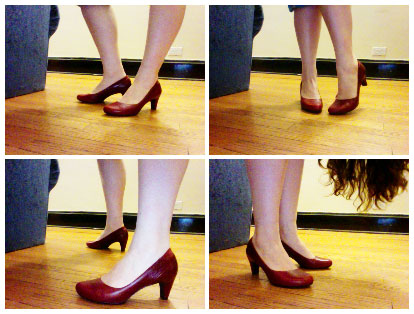
On the plus side, I had a fantastic weekend visit with a very dear friend from out of town, Fringe just got a fourth season, and these hot hot shoes came in the mail for me on Tuesday. So it’s not a total wash. I’m supposed to be taking it easy this weekend, which hopefully will translate into words on paper. I’ll take a note from the ever-excellent Stan Lee: Excelsior!
It was last Saturday, and it was the first time I’d ever been asked that question in earnest. I was at the Chicago Creative Expo, a day of workshops, vendors and networking in the Loop’s amazing Chicago Cultural Center. If you live in this city, you may also know that last Saturday was the St. Patrick’s Day parade. There were very nearly brawls, at least on my end (I don’t care how cool you are, drinking Busch Light on the Brown Line at 11 AM on a Saturday is not my idea of a good time). But once I made it through the throng of green, my grumpiness at waking up early on a Saturday disappeared entirely.
The booth guide said that more than 140 vendors took part in the event, which I more than believe. The energy of so many creative people, who take their creativity and passions in so many directions, all in one place, was thrilling. Not only did I get a gigantic bag of swag (by which I mean more brochures, leaflets and cards than I know what to do with), but I got to talk with dozens of amazing individuals and learn about the ways Chicago’s arts community lives, works and grows. (I’d love to highlight some of them here in the near future. Stay tuned.)
If I had been thinking ahead, I might have gone into this with more of an agenda. I might also have worn a nicer-looking outfit. But I just wanted to fact-find, and get on some mailings lists, so I came in jeans and a t-shirt and totally without a plan. “Hi!” I said, over and over again. “What do you do?” It’s a great opening line, and it started a lot of good conversations. But, occasionally, the topic turned back on me.
“Are you an artist?” the vendor would ask.
If the booth was about painting or dance or crafts, I would hem and haw. “I’m not a visual artist, but I’d love to learn more” was my go-to response. That was how I moved through most of the upper floors. On the ground floor, however, I found my people.
“Are you a writer?”
“Yes,” I said, and it felt really good.
“Are you published?”
“No,” I said, and that felt a little less good. “I’m working on some drafts. I want to be really proud of them first.” To a few, I mentioned Magpie & Whale, and that got a really pleasing spark of interest. Then came the question: Do you have a card?
It had never occurred to me to get a business card for my creative work. Never in a million years. However, I love collecting creative business cards. If I’m ever at, say, the Renegade Craft Fair or an art fair of any kind, I generally take home forty or fifty vendor cards to look up later online. If I order something on Etsy and the seller includes a card, I’m thrilled. I love them as little portable expressions of a person’s work.
What I realized was that, for all my talk about how I want to be a storyteller, how this is the real work I want to do with my life, in a way I wasn’t taking it seriously. Many a writing blogger, for instance, will talk about how much work and sheer elbow grease you need to accomplish when crafting or selling a book, to which I nod along and assume that comes later. But you know what, it turns out that’s not something that I only get to do when I’m a “real” writer, because I’m a real writer now. No more waiting to be anointed by a publisher: I’m a real writer now!
Still, holy cats, if I’m a real writer, doesn’t that mean I need a real business card? How much do I need to do? I could go for letterpress — people really like letterpress. Heck, this place has some options for $95 — a steal! Or maybe I could buy some stamps and make my own — people love that personal touch! Summer Pierre just got some great ones made, and as you can see in this post, Moo is highly addictive browsing. And yikes, maybe a business card is overkill — I’m a real writer now, but maybe a minicard is more suitable at this juncture. Maybe?
Hang on, says my voice of reason. Didn’t we just go over this? Yes, yes we did. Business cards are convenient ways to spread the word about one’s work, but the work is still the most important thing. I keep noting to myself that for all the ideas I get for the creative responses on this site, I’m still working on actually carrying them out. Consistency is what’s going to keep this venture going, as with any project or skill that needs practice.
So, no business cards just yet, even if they are really cool. But hey, the big red bag of swag is still full of treasure. And you’d better believe I got some ideas for neat promotions. I’m trying to stay focused and not get too ahead of myself.
Still, is it ever too early to dream? There’s a rhetorical question for the ages. “Do you have a card?” the vendor will say, and I’ll smile, and take one from a very nifty carrying case, and I’ll say, “Yes. Yes, I sure do.”
I’ve lived in Chicago long enough that being in the city itself can get a little mundane. Granted, I still choose my seat on trains and buses depending on the view I’ll get, and I continue to be giddyinlove with this place, but finding new things takes closer observation now.
Truth be told, most of that closer observation leads me to people. I’ve had some amazing people-watching over the past few weeks. This city is great. I love that this is all nonfiction.
Restaurant, Wrigleyville
A mother and a daughter (I’d put them around 60 and 28) at the next table have already finished their meal when I sit down. They do not stop talking for love or money. Apparently the daughter is having some sort of apartment trouble, and the unit isn’t warm enough for her to be in at the moment. Regardless of context, the mother keeps saying, over and over again, “They would never do that in Wisconsin.” I hear all about the different places the daughter has lived, including Mexico and New York, what trouble the daughter has with remembering to pay bills, and trips to visit relatives. The mother is content to only respond with her thoughts on how unlike Wisconsin every other place is. By the time I’m done with my meal, they’re still talking and haven’t moved from their seats, though they’ve had their coats on for at least half an hour.
Coffee shop, State Street
There’s a girl, 14 or 15 at the outside, and already strikingly beautiful. She’s still young, despite the ankle-length black coat she won’t take off. It’s a great coat, and it really sets her apart from the group of early teen friends she’s here with – she’s obviously staked out her place as the smart, edgy one, and she carries herself with a wonderful self-possession and confidence. To me, this coat is the kind you buy because a character in a book or a comic you love has one. To my untrained eye, it seems like a manga costume, more dramatic than practical. As fabulous as this girl looks, though, she’s got white gym sneakers peeking out from under the hem of the coat. It endears her tremendously to me. I want to compliment her, for her great coat and on her sartorial future, but I don’t want to be weird.
Brown line, North Center
The two blonde girls in front of me are reading the same YA book together. Their shoulders and the fake fur ruffs on their hoods shake as they laugh silently at the text. One has a brown coat and a brown-and-white scarf; the other has a white coat and a brown-and-tan Elmer Fudd hat, with polka-dots. As we head south, they giggle more and more, but otherwise they don’t exchange a word. They even turn the pages just by checking in with each other. I wish I could see the title of the book, but they’re shoulder to shoulder, doing their own thing.
Brown line, Lincoln Park
This older couple is sitting together, holding hands. He’s a big man, bald on top, with a very expressive face. His hands are huge compared to hers, but also expressive. She’s wearing a bolero hat and keeps her gray hair long and loose. They’re not making a big deal of it: they carry on a conversation and look out the windows, but they’re still holding hands. Despite being on a late afternoon train, they’re very intimate and comfortable. I try not to catch the husband’s eye while I’m watching; the wife is with her own thoughts, and doesn’t look my way. They get off at the stop before mine. He follows her, carrying her tote.
Most of the tabs I have open right now are for drafting tables. I am not allowed to have one, but I can’t stop myself. Looking at drafting tables gives me wild, extravagant dreams of using drafting tables, and these days I have one ambition above all: I want to draw comics.
Not just any comic. I want the comic that is the movie I will never get to make. I want the comic about Telemachos, the son of Odysseus and Penelope, who I feel has always gotten short shrift from others who love the Odyssey. I can see it all now: it’ll be so good! Gunnerkrigg Court good! Dare I say it? Sandman good! I have devoted years of my life to this story already, and maybe, just maybe, having all the stuff one uses to make a comic will enable me to churn it out myself.
There’s a snag, of course. I have no experience either writing or drawing comics, and supplies do not an artist make. Not all is lost, though. I do have one thing on my side: I love this story more than I can possibly say, and I think loving the story will compel me to learn how to tell it in a new medium.
When I think about it, this has already been the case in my life. I was introduced to the Odyssey when I was 7 years old. We were on a family car trip, and my mom got the audiobook from the library. I was enthralled from the get-go. The Odyssey is an oral poem, meant to be heard more than read, and I was introduced in the best possible way. When we got to the end of the tapes, I promptly asked to hear the first cassette again. I wound up renewing the audiobook so much that the Athens Public Library banned me from borrowing it, and my parents had to buy it for me.
Some fruits of a lifelong habit
Two things happened. I began seeking out other books related to Homeric epics and Greek myth, and I began writing my own related stories. Hardly a day passed when I didn’t have my nose in D’Aulaires’ Book of Greek Myths or Black Ships Before Troy or The Firebrand, Marion Zimmer Bradley’s feminist take on the Iliad. This last I must have read two or three times a year from the time I was 8 until I was a teen. Meanwhile, I was working on my first chapter book. I had been writing little stories since I could type, and making them up since I was much younger. Theatride’s Odyssey was my own sequel, in which the goddess Athena gives a long-lost daughter of Odysseus a magic ring. The ring enables Theatride to turn into any animal she wants, and will aid her in her quest to defeat a far-off tyrant.
I was devoted to that story. I kept a notebook where I jotted out plot ideas and scenes and characters. I wrote it out longhand and then typed it on a typewriter, to make it more official. I even provided a few illustrations. The whole thing lived in a crisp new folder specifically for the story. It wasn’t short, either — by the time I finished it, I think I had twenty-five double-sided sheets. I’ve been writing epics ever since. (Somewhere on an old Macintosh Performa may also be my attempt at epic poetry, a Redwall-style story called Lilywood. The prose stuck more than the poetry, but it was also a direct attempt to mimic Homeric texts.)
The Odyssey was also my gateway into academia. It’s the reason I got into my major at school (we called them concentrations), and I wrote my junior paper, the equivalent of a senior thesis, on Telemachos and why he is both a worthy successor to Odysseus and his own person within the poem. My junior paper remains the hardest I’ve ever worked on a piece of nonfiction. I had never bothered as much as I should have with things like revisions and multiple drafts, so on a technical level, my advisor demanded much more than me just coasting by. Trying to please her made my writing much better, but it was in conversation with her that I truly learned how to analyze and argue. I remain incredibly proud of my junior paper. As I reread it recently, I found myself missing that kind of rigorous engagement. If Homer becomes the reason I go to graduate school, I will laugh.
Telemachos gets me where I live. His story has always been the one that’s moved me most. Odysseus and Penelope may speak to me more when I’m older, but Telemachos is the child of two famous parents who has yet to define himself. He must take control of his actions and his place in society, and he must leave home to do it. Over the course of the poem, we watch him grow up tremendously, and when the poem ends, he is faced with enormous ethical and political questions, not to mention adjusting to a life with his absent father at home. There is nothing dull about him to me, and I am champing at the bit to share that with other people.
Two weeks ago, I wasn’t nearly this passionate. But, as the Homeric poet might say, the god intervened. As I was walking up Broadway with a friend, I spotted the spine of a familiar book on a sidewalk sale cart. It was The Firebrand, which I hadn’t read since I was 12 or 13. I had exact cash in my wallet. I was doomed from the start.
Communing with my childhood
Rereading The Firebrand has been an experience, and a story for another time. I still see why I loved it, and I also catch things that went over my head as a kid. This was the first time I’d encountered a transformative account of the Trojan War, one that didn’t take all the heroics and myth at face value. Achilles is a petulant, amoral brat; Odysseus is a low-class pirate; centaurs are just wild men on horses, and women rule their city-states as Queens with upstart consorts. Our narrator is Kassandra, daughter of Priam and Hecuba, whose prophesies of disaster always come true and are never heeded.
At one point, Odysseus relates how he was conscripted into war against Troy. Agamemnon, the king of Mycenae himself, came to Ithaka to fetch him. Rather than leave his wife and young son for a war he wanted no part of, Odysseus feigned madness. He dressed in rags, harnessed an ox and began plowing a field in crooked, erratic lines. Agamemnon was brought to see proof of Odysseus’s unfitness for himself. But he was no fool either: he scooped up toddler Telemachos and set him in the path of his father’s ox. Odysseus had no choice but to swerve, proving him sound of mind. He left for Troy that very day.
Wow, I thought as I read this, what an opening shot. It was totally involuntary. That was the moment it seized me, this need to make this story into a comic, which wouldn’t require all that a filmed version would. The next weekend I found myself in a Border’s liquidation sale, shelling out for huge sketchbooks and a truly lucky find, Drawing Words and Writing Pictures, a fabulous textbook for a comics-making course. It’s reading through this that’s made me want a drafting table. I’m dreaming now of t-squares and Ames Lettering Guides. But I’m holding myself back, and not just because I need that money to eat and do laundry.
There’s no sense in buying all the supplies before I know I’m going to use them. I hope this isn’t just a flash in the pan, but I have to earn these things with a lot of practice and a lot of mistakes before I invest in them. Even the storytelling, something I have a lot of practice doing, will need some adjusting as I figure out this new form. If I can make drawing and lettering and panels and ink a regular part of my life, if it becomes something I will do consistently, then maybe we can talk materials. First step: closing these tabs and breaking out some pencils.
I’ve got this, though, cheesy as it might sound. I love this story. Hopefully, when I’m finished, so might you.
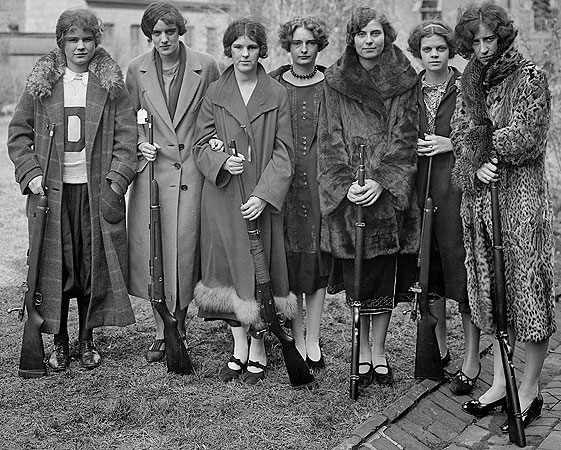
Yesterday on Twitter I was pointed to an excellent group portrait on Shorpy, one of my favorite sites around. One thing led to another, and the 1925 girls’ rifle team of Drexel Institute began talking. You know how it is when ladies get together. From left to right:
Then there was Tess. She was new to Drexel, and sometimes wound up jockeying for power. Dolly always came out on top, but Tess was a good sort, so we kept her around. She made things interesting, particularly with her sweaters. She was a ferocious knitter too.
Bitty, well. We called her that because she told us to. Something about her mother always thought she was too tall. We went along with her.
Alice and Bitty, they were always real close. Alice was old money, but she rebelled by wearing out all her old things until they fell apart.
One time we had to gag Eulalie up to get her to stop talking. You’d think it would be immaterial while shooting, but she was a distraction. She took it pretty well, though. Eulalie was always pretty cheerful about ropes. We blamed it on her being a Girl Guide. Rue wasn’t so sure.
Dolly, she was our leader. She was a natural, with a face that got your trust at once. A fine sniper with a fine coat and great shoes.
Fran rolled her own cigarettes. Her brother ran rum across Lake Superior. She was just in the rifle club for the socializing.
Rue never talked about her husband. We saw what she did to that line-up of soda bottles when Eulalie asked about her ring. Rue had a great laugh, though, when you got it out of her. She and Dolly could really cut a rug after practice.
We kept each other interesting.
All this happened at @magpiewhale. Follow along and see what else happens!
I know, I know, I never write, I never call! Last week I got caught up in my head about what to write for Monster Mash, and this week I’ve been caught up in, well, I don’t know what. But I wanted to share a post that I wrote for another blog!
Oy!Chicago is a blog collective for young Jewish twentysomethings; I’m a regular contributor, usually writing about health issues, but occasionally I get to add something a little different. Today, it’s taking a look at the brilliance that is @MayorEmanuel, the fake Twitter account of Chicago mayor-elect Rahm Emanuel, who over the past month has really put us through the ringer. I take a look at the implications and the effect this has had on its readership, along with some thoughts on what makes the experiment so great.
(As for my own Rahm story, I did get to shake his hand at an El stop this election cycle. It was on the day he was struck off the ballot for the residency issue, and I was very impressed that he was down at the turnstiles in the State and Lake station, rather than huddled in a conference room or raging from a podium. Yeah, call me impressionable, but it was neat. He’s not a big guy, but I liked that I got to shake his hand. Yes, it was the hand with half a middle finger. He said “Nice to see you” and then moved on to whoever was next. I’ve had my brush with greatness. And who’s to say I didn’t meet @MayorEmanuel himself?)
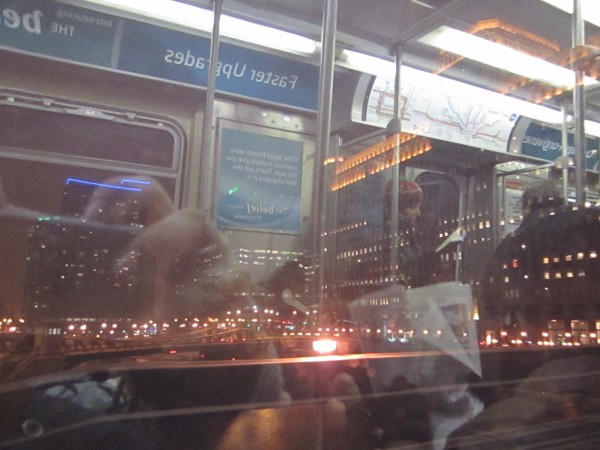
Mummies assaulted me on the train last week. I wish it was as funny as it sounds. Some local museum (I suspect the Field) is hosting an exhibit, and the blue posters seem inescapable on the CTA. I can’t actually tell you more than that, because I am too terrified to look. The two preserved heads on either end of the ad are just too much for me.
As soon as I saw them, the physical reaction was instantaneous. I felt nauseous, claustrophobic, shaky, dizzy, cold. I couldn’t look anywhere but down at my knees without seeing them: the ad reflected in the window next to me. At least three stations displayed the ad on the platform, much bigger than an overhead car poster. As soon as I got to my stop, I ran into a convenience store for Cheez-Its, my ultimate comfort snack. I stress ate all evening, exhausted by the tension of trying to avoid those mummified faces, and knowing I’ll be repeating it until the CTA bothers to take them down.
Mummies are my bugbear. I literally cannot comprehend how they don’t repulse and terrify everyone else. They’ve haunted me my whole life. First was Ötzi the Ice Man, the oldest known mummy, who was found in the Austrian Alps when I was 6. PBS aired a special on the discovery, and I sat down to watch with my parents. When I saw the Ice Man’s skin, discolored and distorted and very, very dead, I shot out of the room. From then on, I could never abide mummies. When I received a gorgeous Dorling Kindersley Illustrated History of the World one year for Christmas,I had my parents go through it first and tape over any images of mummified bodies. (They knew to go through Egyptian history; that was when I learned they had mummies in Peru.) When my sixth grade teacher had us transform our classroom into an Egyptian pyramid, I learned to studiously avoid the pictures taped up on the wall; obliging classmates would bring the DK Mummy book up to me and shove it in my face.
When I was 13, we took a trip to London, my first. One day we went to the British Museum. I thought I would be safe in the Norse and Celtic wing, among the beautiful metallurgy and woodwork. Instead, I turned a corner and came face to face with a human sacrifice who’d had his throat slit and been dumped in a bog more than a thousand years ago. My mother stayed up with me all night. I was too scared to sleep.
This all begs the question: what did mummies ever do to me? I think of Nora, our basset hound. Once when she was a puppy, the divider gate fell on her; her whole life after, she skittered out of the way if the gate began to tip. Haven’t I outgrown my horror of mummies? Two of my favorite TV shows, Fringe and Supernatural, both frequently show old bodies in varying states of preservation, often freshly exhumed. I can mostly deal with those. Then again, these CTA ads have no Jensen Ackles or Anna Torv to distract me. There’s just those sunken, leathery, grimacing heads.
The reasons I am scared of mummies have not changed since I was small. Of course, yes, they’re horribly ugly, all bared teeth, caved-in skin, ragged flesh and protruding bones. But even as a child, I could not reconcile the mummy’s appearance with the fundamental fact that these had been people once. Knowing all the grim details of how the ancient Egyptians “perfected” mummification, down to the canopic jars and the removal of the brain through the nasal passages, only made it worse. These terrifying things had once been people. They laughed, they felt things, they had friends, they made choices, they grumbled about the weather — they were people, and now they were shriveled and mottled and not even whole. We even know individual names, in some cases: this shell was Nebemakhet. He wrote poetry. He loved his wife. He died four thousand years ago. Here he is.
This seems like fairly standard dead body horror. I have also, for instance, never been a huge fan of zombie stories. But zombies, while stomach-churning, don’t fill me with the same terror that real mummies do. The key difference, I think, is that mummies consented to mummification, enthusiastically. Perhaps there’s some cultural element at work, given the kind of Jew I am — letting any body go unburied for more than 24 hours is incredibly discomfiting to me — though I wouldn’t assign that too much credit. People with great interest in mummies have explained their perspective to me, how the thrill of a mummy is precisely because it’s a connection to another time. I really cannot let go of that transformation, from living human being to husk: the continuity of the person and the choice to embrace and glorify such an end is the source of its horror.
I never thought I would need to desensitize myself to mummies. We don’t see them often unless we seek them out, so I was always certain I could merrily go through life avoiding them. In stories, confronting fears of this magnitude becomes a plot point. The past week or so has not cured me of this fear, and it has not helped me control it. I have to check train cars when I get on, and if the ads are up, I have to position myself so they’re out of sight, mostly out of mind. Even then, if I can people-watch, I wonder what my fellow riders are thinking of those images. Do they notice? Do they care? Are they are surprised as I was? Are any of them scared too? And if it’s not mummies for them, what am I missing? Who wishes they could look and blithely forget what’s there?
In third grade, I thought I was a pretty great reader. I was totally into chapter books, and read virtually anything I could get my hands on, with many thanks to our library and the Scholastic Book Club catalogs. I also loved animals: the year before, we’d finally gotten a dog, and I had spent a good deal of time utterly obsessed with Jack London books and The Rats of NIMH.
My friend Tristan had this new hardback. I’d seen him carrying it around, but hadn’t investigated. It was more than an inch thick, and the clothbound cover – I seem to remember it was maroon – had only a single, shiny title on it. When I asked him about it, he told me it was a chapter book with only tiny pictures at the start of each chapter. And that good guys sometimes die. I was rocked by this. Somehow it hadn’t occurred to me that that could happen, and the fact that someone my age was reading this book meant that I could too, and should.
The book was Mattimeo. The rest is history.
I devoured the Redwall books from the age of 8 until I was nearly out of college. I loved the epic quests, the unlikely friendships, the different clans of animals, the loyalty, the scoundrels, the betrayals, the adventure, the strangeness, the feasts. I truly think I read some of those books more than a hundred times each. Mattimeo, The Bellmaker, Salamandastron, Mossflower – these are formative texts for me. Because of Redwall, I went to the library and asked for similar books or bigger books. The librarian gave me The Cold Moons by Aeron Clement, my first adult fiction book, and of course, the great Watership Down. Once I had a taste of the Adult Fiction section, and wasn’t so scared of it, the whole library was open to me, and I read everywhere.
Being dissatisfied that there were no wolves in the series, I began writing my own stories, which rapidly became a sprawling series of my own, which I illustrated and read aloud to my mother on car trips. (They’re fantastic stories, by the way, combining all the best features of the mid- to late-90s alternative pop music scene with The Lion King and dashes of unintentionally postmodern humor. I’m not actually being snide: I have a tremendous soft spot for that period of work.) Writing those stories made me push myself as a storyteller, and it also made me someone who writes, regularly and constantly, for fun. I am not a writer or a reader because of Brian Jacques, but he had an outsized hand in it.
Usually I skipped the long lists of dishes, and, unless it was plot-related, the poetry, but the world of Mossflower, oh, I wanted it dearly. How I wanted to be an otter or a hare, and to terrorize the kitchen and go on quests and have friends who would die for me or the other way around. How I saw Mossflower in Appalachia growing up, the lush forests and rivers and mountains. How I wanted to see the ocean the way Jacques did. And yes, there did come a time when I realized that each book was the same book as the last one, but it was the same wonderful story, and it never stopped me from loving it.
Brian Jacques passed away suddenly this weekend, on Saturday, February 5th. I have lost my chance to thank him directly for all that he has given me, and that does grieve me: I truly thought he would be around forever, and that Mossflower would soldier on and on and on. Still, just because a person is gone does not mean they are lost: his books taught me that too, over and over again.
So, thank you, sir. Thank you for Gonff and Columbine. Thank you for Mariel and Dandin. Thank you for Tsarmina and Slagar the Cruel and Ferahgo the Assassin and General Ironbeak. Thank you for the Foremole and Log-a-Log and the Skipper of Otters. Thank you for Dibbuns and St. Ninians and the Long Patrol and the River Moss and the tapestry. Thank you for meadowcream and hotroot and October ale and deeper’n’ever pie. Thank you for Badger Lords and Badgermums and countless abbots and abbesses, for friars and recorders and cellarkeepers and novices. Thank you for maps and riddles and ships and dreams. Thank you for swans and pikes and snakes and bats and wolverines. Thank you for the dialects. Thank you for Basil Stag Hare and Queen Warbeak and Finbarr Galedeep. Thank you for the Bloodwrath and the Gullwhacker, the Mace, the Axe, and of course, the Sword. Thank you for showing that the world is complicated, and that the good guys can and will die.
Thank you for all those hours when I could have been doing something else. Instead, you took me somewhere, and I began to wander.
One of my dearest friends recently posted a meme that started, in its present iteration, with author Catherynne M. Valente: List 25 Things I Want Before I’m 50. I saw Cat’s list (which seems to be gone now, or at least no longer public), with some of her items already crossed off or progressing, and felt very insecure and unaccomplished. Seeing my friend’s list made me want to do it. Maybe it’s easier not to quail when your friends share extravagant dreams, and maybe it’s more thrilling watching someone you know be so deliciously ambitious.
I’m sure this is a twentysomething thing, but I have many days where I can’t shake the feeling that, even as I push and act and do, I’m still waiting for something to start. My list seems full of novice things, and there are days when I wilt, comparing my life to others’. Of course, one of my most salient, obvious features is being terrifically hard on myself. Clearly one of my less concrete goals is to shed that tendency as much as I can.
Putting this list together was hard. I am not good at planning for the future, and never have been. The exercise was a good one, though, because I began to see patterns in the things I want for myself. All my angst about finding a career especially becomes a little funnier, because it’s obvious to me that I have a career: it’s just one that’s tremendously hard to get hired for, in effect. My career is storytelling. It’s my day job that I need to solidify.
These are in no particular order, other than the first one.
Be widely read. Get published. Do the work and finish things and share them. Make art. Tell stories. Engage with people. Maybe inspire some of them. This is the Thing I Have Wanted virtually my entire life. It’s a little uncomfortable and strange to be so brazen about it, but of all my ambitions, this one is the foundation. I want to talk to people about the world, and I want to do it with art.
Develop musical talent. Learn to sing for real. Play instruments again. When I was a kid, I played piano, oboe and bassoon, and I always loved singing. I miss that, and now that I have a better idea of my tastes (this item could have read “Learn to be Neko Case”), I have a better idea of what to pursue. Someday, Old Town School of Folk Music. Someday soon.
Own custom-built vintage-inspired clothing. I love lines in fashion. I love how clothing of a certain era is both feminine and strong. People often tell me I should have been born for anytime between the ’20s and the ’50s. Personally, I’ll stick with contemporary civil rights, modern medicine and the internet, but oh, do I love those looks. I’m tall, 5’10”, so period clothing rarely fits me. But reproduction designs are becoming more available, and I like the future very much.
Spend a significant amount of time traveling abroad. Take a year and just go. Optimally, before grad school. Leave no room for regrets. There’s so much I want to see, I can’t even begin to get into specifics.
Own a dog. Be a responsible dog owner. I grew up with a basset hound, and before that had wanted a dog almost from the time I knew what they were. It’s a constant longing. I just love dogs.
The Great American Road Trip, at least part of it by train. I’ve done a little of this, and it’s always been the highlight of my year. In 2006, I took the California Zephyr from Oakland to Chicago, and I fell completely in love. (Did you know Amtrak makes a great hamburger, by the way?) In 2007, I outran winter that February and headed south, into Georgia and the Carolinas, and it gave me what I needed to get out of Ohio and move to Chicago. I need more Great American Road Trips, even if they’re only a week at a time.
Take photography classes. I love my camera. I love taking pictures. I would love to be able to justify one of those gorgeous DSLR cameras and get really inventive and attentive.
Take acting classes. I’m not a Theater Person, who lives and breathes the theater and who can devote myself to the stage the way that life requires, but I love acting. I also think, like improv, it would challenge me as a human being, and I think that would help me in a lot of areas of my life.
Find a career. Figure out what to do and how to do it. Go to grad school. As soon as I articulate to myself how I can go to grad school in being Studs Terkel, I will be set.
Be more bodily active. I have a love-hate relationship with sports. There’s some measure of snobbery and shame that I need to overcome, leftover from public school, because I surprise myself with aggression from time to time, and I clearly need an outlet for that. Kickboxing, biking and roller derby all sound kind of amazing to me.
Have a family. It interests me how far down the list I put this, or rather how comfortable I am with bringing it up. I want to be putting kids through college when I’m 50, or at least working up to it. But yes, I do, in fact, want to marry and reproduce. I don’t think it’s inconsistent with any of these other wants.
Live abroad? My ambivalence on this one is also interesting to me. It’s certainly, at this point, more important that I get to move and travel, rather that live somewhere else. I wouldn’t mind it, though. I think I just have to be sure of the circumstances.
Write that book. The nonfiction one, about transformation and war and a few other things.
Have a hand in making a movie. Or a TV series. The most consistently good filmed entertainment is in TV these days. I think it’s more suited to my love of long stories too. My only problem is I don’t think I could bear living in Los Angeles.
Do something drastic with my hair. Cutting it, dyeing it, whatever: I want to challenge myself and try something new and less safe.
Have a writer’s circle that meets in person. Whether this means we’re all local and meet once a week, or whether we communicate online and get together once a year, I would love to have that, a small community of people I trust who want to tell stories as much as I do.
Collaborate more. I am a bit of a control freak, and have not entirely learned how to do collaborative creative projects. I am intensely envious of those who can, whether it be co-writing a story or creating a comic with an artist or doing something amazing and multi-media. I would love to create things in conjunction with other creative people. I think improv gives me a taste of that, and I’d like to branch out.
Lose my fear of bullies. Speak out more and earlier. This is a lifelong thing of mine. I imagine I will write about them a lot, as practice.
Have a greenhouse. And a garden. Alternately, acquire discipline and a green thumb.
Have a rural space I can always come back to. I grew up in Appalachia, and I miss it, dearly. I also have something of a desire to live there again, even given how much I love cities. I’ve seen what it can do, and I know what I get out of it. Someday, hills, I’m coming home.
Learn to dance. Especially swing. I would really love to get out of my head about dancing, because while I’ve long convinced myself that I am awkward and possessed of two left feet, I think I really just need to not be so self-conscious. I also have a secret desire to be part of a group with a dress code and an ethos, inasmuch as you dress up for swing dancing. See #3 for more.
Sort out the place of religion in my life. I’ve been an atheist since I was 4 and realized that Genesis had left out the dinosaurs in the Garden of Eden. I am also Jewish, and I consider that a very important part of myself and my family. The atheism and the Judaism are far from mutually exclusive, which is one of the things I love about it. As it turns out, I have opinions on what services should be like, and I would like to find a community I’m comfortable in, even if it’s just for the holidays. (Trust me, no one was more surprised than I was.) So far, no dice, though I haven’t been looking like I could be.
Give. Be secure enough to support the causes I love financially. One of the hazards of working in nonprofits, I guess, is being impressed on the importance of giving. I would love to be a consistent, change-effecting donor.
Be a better correspondent. How much I stay in touch with someone is never any measure of how I feel about them. I love many people dearly that I utterly fail at communicating with on a regular basis, and it eats at me. I never quite know what to say, especially if the silence has been long. I need to get over that, and to make it not be a problem in the first place.
Go whale-watching. The oldest want of all.
A few times, I was tempted to be more whimsical. “Screw world travel!” I thought at one point. “When I’m 50, I want to have gone into space!” A few other times, I thought, “Oh my god, I am only 23 and a half years away from my 50th birthday, I am running out of time.” In both of those instances, I had to stop and laugh. Somewhere on a writing blog, I read a reminder that the Sears Tower was built by lots of little actions, lots of individual bolts and rivets going into lots of smaller pieces of steel. It didn’t happen all at once, but it was accomplished, because of many actions that seemed too small to matter. As someone who works in the Loop close by, I can appreciate the weight of that analogy.
I’m glad I have this list now. I’m looking forward to coming back, maybe revisiting in a year, and crossing a few things off.
Today was my first snow day since high school. Despite the semi-apocalyptic storm that battered Chicago and most of the Midwest, as people were digging out today, they were remarkably cheerful. I hope most of them had good days: I sure did. I slept in and took pictures and mooched around and romped in the snow. Granted, I also had plans of being productive. I have stories to plan, essays to write, novels to organize, sketches to draw. Instead, I romped in the snow.
I consider this a fair trade. But I’m also cognizant of the fact that while the nonfiction part of this blog has been fairly easy for me, the creative part has been like pulling teeth. I second-guess myself like crazy. There is stuff happening — you guys just don’t see it. But one good thing did come out of my mindless web-surfing and lazing about today. In the course of trying to figure out what the publishing implications of a project like this would be, I found someone else’s old post wrestling with a very similar thing. I’d been trying to remember the thing about first publishing rights for a while now, but it was a comment to the post that really caught my eye:
People who worry overmuch about piracy sometimes reveal a fear that their genius is finite, like “I mustn’t let that be stolen in case it’s the last good idea I ever have”. What can happen is that the acceptance of early work – even if it is no more than acceptance by plagiarising and theft – is so encouraging that it fosters feedback and releases a whole lot more ideas. Rejection by publishers is such a downer that it has snuffed out many writers, but a positive response from even a stolen copy of your work may inspire a whole new writing impulse. And you, Sarah, have a lot more to give the world.
What a lovely thing to hear, and truly, just as I needed to hear it. (My own paranoia isn’t about losing money or losing out on contracts, specifically, but I am nervous about being taken advantage of, which is about as useful a worry as any other irrational or unanswerable worry. As with improv, the internet is not kind to control freaks.) Slowly but surely, self. Thanks, Lionel. And readers, stay tuned. Thanks for your attention: we’re back to your regularly scheduled programming soon.









 Magpie & Whale