GRE is to career planning as escalation is to…

If a protagonist has only one problem to sort through, there isn’t much of a plot. It’s by layering demands on our heroine that a story becomes interesting, especially if they’re in competition with each other. Apparently I am taking this formula to heart, because in addition to work, in addition to this project and in addition to trying not to become a hermit who can’t cook for herself, this week I accidentally signed up for the GRE.

“Accidentally” is a strong word, but it’s nearly accurate. One minute I was reading about application deadlines, the next I was giving my credit card to ETS. To put that in context, I’ve been resisting grad school since about 2005. I’ve always known I wanted to go, but I don’t want to be in academia, and I knew I couldn’t justify more school (and more debt) unless I was certain the degree would steer me toward a real career. Thanks to a recent graduate school fair organized by Idealist.org, I think I’ve finally found it — or rather, I’ve now got the name for the thing I’ve wanted to do all along. Which is great — a huge relief! I finally have a path, a plan, a set of options to pursue.

I also now have the GRE to study for, applications to compile, essays to compose, visits to arrange, decisions to make. This on top of work, friends, family, freelancing and Innogen. It was the right decision, but my timing is hilarious. Onward!

Last week Imogen got quite the suckerpunch, meeting Cloten, who looks just like her best friend and acts nothing like him. Let’s see how she’s going to deal with that!

One song

“Bang Bang (My Baby Shot Me Down)” by Nancy Sinatra [lyrics]

Hey, remember that time when your certainty in the most solid thing in your life got yanked out from under you? Man, that was rough. Poor Imogen. Now she has to spend an entire dinner party with it.

Two links
I’ve mentioned before that most of my knowledge about the Roman Empire comes from the Asterix comics, which means my general idea of what food in Ancient Rome looks like is something close to this:

From Asterix in Helvetia

Luckily there are scholars who disabuse us of hilarious, parodic simplifications, and who publish cookbooks of actual recipes from imperial Rome! I’ll never be embarrassed by my ignorance of how to properly cook an ostrich again. By Toutatis, I’m relieved.

The second link is mainly visual, and explains why I’m really writing Innogen.

Three lines

“Even Argus wasn’t invincible when Mercury came to play him to sleep.”

Rigantona smiles. “The Romans have gods, stories and much else, Lady Imogen, but I assure you, they do not have this.”

That’s it for now. Swing back Tuesday to see how it all comes together! As always, no knowledge of steampunk or Cymbeline is necessary to enjoy Innogen and the Hungry Half, but if you’d like to read the play, MIT has the full text available for free online.

Innogen and the Hungry Half: 02 – To th’field, to th’field

Previously: Photoplate wizardry, novelty waffles, a boy named Posthumus, tiny automatons, revolts in Illyria and a public demonstration.

My nursemaid was the second person to hold me, after the midwife and before my mother. Dorothy needs only a glance — at my poorly made bed, my bramble of hair, my correspondence in its neat stack — to sigh from the doorway and insist again that I should never have gone to the exhibition palace. The dawn chorus is finally underway; my blood will hum all morning. Dorothy arms herself with a brush and takes up her post behind my seat.

“You knew it would give you bad dreams.” She cards out a knot. “And don’t tell me Posthumus needed you there that much.” She sighs again, pointedly. “Imogen, your nails are full of ink.” Still, she pets me on the crown of my head.

“That’s what gloves are for.” I study myself in the mirror: a little powder should mask the bruised eyes. “Varinia will never know better.”

Dorothy focuses on a section of hair. “Is that who you’re seeing today?”

“Among others.”

“Then we’ll plan accordingly.”

When Helen arrives with my schedule and the morning papers, I am ensconced in my dress, with my hair bound up after Rome’s latest fashion. I’ve gone through half a pitcher of water, and feel armored against the day. “Iudocus has sent me three messages since dinnertime,” Helen huffs. “That man should be old enough to know a little patience.”

She hands me the stack of dailies, two in Latin and one in Briton. “I suppose he wants to meet as soon as possible.” I scan the headlines. Price of cattle rising. Fire at the docks contained. Trial opens on famous murder in Herculaneum. “Has he been clearer with his reasons?”

“Isn’t his urgency reason enough?” Helen runs a pencil over my schedule. “I’ve cleared your morning, as you asked. Varinia at one o’clock, Brisius at three about the proposed public bath, the Iceni caucus at four to line up support for the currency measure, a few minutes with Larcius Saturninus to check in on the census, and dinner with Rigantona starts at seven, so we’ll return no later than six.”

“Brisius does not want the bathhouse, correct?”

“Yes; it clips the site of a sacred grove, and the Romans are making no allowances.”

“I see.” Dorothy hands me a pair of earrings: lapis drops, a gift from the praetor of Lutetia. She sets out another box, a gold necklace smithed at Durobrivae. “How about the studs from Leucomagus, to change into?” She nods and sets off to find them.

With a knock, Posthumus ventures in, dressed for the master of the yard. Dorothy sighs again, and Helen engages herself with her notes. Posthumus’s shoulders go looser. “You’re looking better.”

“A good night’s sleep will work wonders” is what I say, before I lean to look around him. “Good morning, Pisanio!” Posthumus’s manservant steps in from the hall, holding his hat. He brought the newborn Posthumus to us as a marooned boy of twenty; I don’t believe they’ve spent a day apart since.

Posthumus nods at my array of hairpins and jewelry. “Another day at the front?”

I can only gesture back. “And for you as well, it seems.”

He laughs. “Fencing this morning.”

I lean on my elbows. “Will you need that, when you have found your trade?”

Posthumus shrugs. “One never knows. I hear scientists are a ruthless sort. Speaking of which.” He digs into a pocket, and produces the butterfly from yesterday’s event. I glance at Helen, whose mouth twitches. Its wings have been straightened, and its legs hang at their intended angles. “I thought you might want this, for your dinner tonight.”

Away from the crowds and the machines, it’s innocuous, even charming. He has repaired it expertly. My stomach clenches, but it passes, and I smile at him. “She’ll surely want to meet the man who brought it back to life.”

“Oh, it doesn’t work, not like it did at the demonstration.” He points to its underside. “It’s just a fancy toy when it’s away from her signaling device. But I do have questions about how she did it. The engineering is very fine for something she just gives away.” He holds out his hand. “If you’re able to arrange some time with her, of course I wouldn’t object.”

“You’re very devious.”

“Devious and well-intentioned.”

I pick the butterfly up by its wing and set it by the mirror. “I’ll see what I can do.”

He looks to Dorothy, who is still giving him meaningful glares. “I don’t want to make the arms-master wait.” His fingers brush the edge of my vanity. “I’m glad you’re feeling better.”

He excuses himself, and Pisanio shuts the door behind them. Dorothy scoops up today’s necklace with some force. “It’s not his fault I went,” I remind her.

“Then I will blame Varinia,” she announces, and drapes the necklace at my throat.

I watch her in the mirror, unable to keep from smiling. She’ll forgive him by tomorrow. “And I’m not to blame in the slightest?”

She pats my cheek. “Posthumus may think the world of you,” she says, “but yes, I know you’re still foolish.”

*

When Dr. Cornelius opens his door, his face falls. “My lady Imogen! I wasn’t—is something wrong?”

“Nothing’s wrong.” I peer down the short stairs to his basement laboratory. “May we come in?”

“Please, please!” He steps back, nodding to Helen and me, and rubs his palms together. “Apologies, my lady. Your father is due at the hour, and I find myself a little jumpy.”

“I know. I don’t want to take up too much of your time.” His ceiling is low, and as crowded with instruments and artifacts as the rest of his space. I sidestep a pile of folders marked Peer Review!!! “Why is the king coming to see you?”

Dr. Cornelius hesitates. “I’m a scientist, madame. I don’t… I don’t want to somehow play a side.”

I fold my hands, a pantomime of demureness. “You needn’t worry, doctor. I’m here on a personal matter.”

He seems unsure whether to look relieved or not. Dr. Cornelius came to us from the most distinguished societies in Alexandria, before which he’d been the brightest young biologist in Libya. By the time he arrived in Britain, in need of a patron, he believed he’d failed to live up to his promise. Dr. Cornelius advises the king on scientific matters, while the king funds his research, the shape of which seems Protean. At present, it involves open tubs of briny water, and a half-finished dissection somewhere close by.

He looks somewhat shyly toward the mess. “How may I help you? If you don’t mind, I still need to straighten up a bit.”

We follow him, ducking away from rows of swinging lamps. “I assume you’ve heard of Rigantona.”

“The prodigy? Who hasn’t?” He shakes his head. “Her treatise on EM fields is a classic. In Egypt, we thought she was wasted in Britain.”

We stop at a group of barrels near the door to his hothouse. The glass panes are foggy and, at the corners, green. “Have you seen her show at the Pallas?”

“Not yet,” he says ruefully, his back to us, “but I’ve heard it’s worth the ticket.”

“I know this is supposed to be some sort of comeback for her.” Dr. Cornelius pauses, lid in hand, before setting it aside. I press on. “Why is that?”

“Oh.” His eyes wander. “That’s some very old gossip.” He reaches for a pair of elbow-length rubber gloves draped over the back of a chair. “She presented a very exciting bit of tech that time. A converter of some sort, energy into units of matter and back to energy again.”

Helen snorts, then catches herself. My eyebrows crook up. Dr. Cornelius smiles as he buries his hands in his gloves. “That’s what we all said, but she made it happen, and the math seemed to check out. It wasn’t intended for everyday use, mind you — it was an industrial-grade device. I think she meant it to make Britain more self-reliant.”

“Self-reliant?” Helen glances at me.

Dr. Cornelius plunges one arm into a barrel, working at something stuck to the side. “She’s very patriotic,” he says uncertainly. “No idea too big for her, that was the reputation. Ah!” He pulls up a bright red starfish, as large as his hand. It’s grossly lopsided, one pair of arms far bigger than its others. He examines the underside, his brow knitted.

“What happened?” Dr. Cornelius looks up at me, blinking. “After the exhibition?”

“Oh! I wasn’t there, but everyone read about it.” He cradles the starfish between his fingers. “The evening before the closing day, her device broke down. It shorted out the entire hall.”

I have dreamed that. Dr. Cornelius gesticulates with the starfish, oblivious. “There was an investigation and all sorts of unpleasantness. Obviously the machine was unsafe.”

“I see.” Sleeplessness has numbed me; I file this away, and my knees hold for me. “And this is a matter of public record?”

“I don’t know what is and what isn’t.” Dr. Cornelius tips the starfish back into its barrel. “But to you, my lady, I can’t imagine it wouldn’t be open.” He rifles through his supplies until he finds a bucket, and heads toward the dissected animal on a table nearby — another starfish. The smell keeps me at bay.

“What is all this, doctor?”

For the first time, Dr. Cornelius lights up. “This is a most amazing creature, my lady. In the center — come look! There is a disc—”

“Cornelius!” my father booms from the front door. “Didn’t you hear us?”

When his uncle’s heart finally broke, years after surrendering to the Romans, or so one narrative claims, Cymbeline became king over Britain. My father is equal parts imperiousness and practicality, and does not hate what the Romans can give him. He extends this attitude to all things in life, including my marriageability.

“Ah,” he says, as he strides ahead of his entourage. “I see my daughter was distracting you.”

Dr. Cornelius sets his bucket down with a clank. The dead air stagnates; I step in. “My lord, Dr. Cornelius was indulging my curiosity.” He glances at me, and I smile. “I was hoping he’d explain some things I saw at the exhibition, which he has more than adequately performed.”

My father grunts. “We are here on the same mission, then. I’m to meet with an inventor tonight, Cornelius. I’d like to not sound stupid when she talks about her wares.”

Dr. Cornelius finally shuffles forward, still gloved. “I am no engineer, your majesty, but I can endeavor to outline the principles, if I can.”

“That’s why we keep you,” my father says, dryly, and Dr. Cornelius barks an uncomfortable laugh.

I want more. I want names and contacts and leads, but we are as good as no longer in the room. The king’s advisors murmur among themselves. My father begins interrogating Dr. Cornelius about wireless theory. I have time, and other means. Helen and I show ourselves out.

*

“Oh, I love your necklace.” Varinia holds me by the shoulders to admire it. “So charming,” she purrs. “One of your local artisans?”

I finger the chain, a twist of gold bearing a wide pendant. “Out of Durobrivae.”

“Just lovely.” She slips her arm through mine and steers us through the park. “Italy can be so narrow-minded about the provinces. It’s just suffocating. There’s so much ingenuity in the empire.”

We are an uncommon sight, a princess of Britain strolling with a quaestor of Rome, and I believe Varinia likes it that way. Her official function is one of financial oversight, which sends her to new parts of the empire as often as she likes. I’ve always admired her: she wields her knowledge of money with all the cunning of a king. She first passed through Londinium when I was bored and restless and fourteen. My father has never forgiven her for my abiding hunger for statecraft.

Since her last circuit through Britain, Varinia has picked up the henna fad sweeping Thrace. Her hair flames and sparks in the sunlight, to great advantage. “How is your father? He hasn’t tried to marry you off to anyone horrid lately, has he?”

“Not since Morcant was caught selling favors to fund his vanity press.”

“It shouldn’t have mattered, if only the books were good.” She smirks. “I hope we shall always be friends, Imogen.”

“I trust you to stay careful enough to keep it that way.”

“A high honor!” Varinia chuckles. “I’m glad you’re being sensible about this, even if the wait is long. Pick a man who devotes himself to you, my dear. Only then will I be certain this country is in good hands.”

“You speak lightly of our future king,” I deadpan.

“If you might rule through him, you may as well also be happy.” She thins her lips. “You must be so bored of marriage talk. I’m sorry to bring it up; I have futures on my mind.” She looks me in the eye. “It’s actually why I was so eager to see you. You have as good a measure as any on the mood of Britain.”

Generally Varinia is either blunt or coy; her earnestness throws me. I frown and stare ahead of us. The protestors at the Pallas spring to mind. “Is this about Illyria?” I ask quietly.

She rolls her shoulders. “You know how it is — one province sees another act up, and not to follow suit is to admit weakness, while Rome overextends herself.”

“Such is the trouble with vassal kings.”

“I’m not being condescending, Imogen.”

“My father is independent, but he’s also loyal. You know how he fought to have the exhibition here. We’ve earned our goodwill.”

“Nonetheless, Caesar’s armies are in Dalmatia and Pannonia, laying waste.”

I say nothing for a few minutes. “Who says Rome is overextended, the politicians or the soldiers?”

“It doesn’t matter who said it, now that people have heard it.” Varinia stops and leans close. “Imogen, your father is a good king. He rules with a strong hand, and I am more than certain he could keep his chieftains in line, should there be any trouble.”

I watch the passersby over her shoulder; a few glance our way, though not for long. “But?”

“By the time the king bullies his way to unity, the idea will be in every public house and private home in Britain, and that is hard to control.” Her focus on my face is intense. “You are quiet. You are discreet. And you could be as strong a hand as he is.”

I huff in disbelief. “Should I ready myself for a coup?”

She lays her hand on my arm. “I am saying you must do everything in your power to keep things from getting that far.” She begins to walk again, and I fall in step beside her. “The Illyrians broke the Pax by refusing to pay their tribute. It started earlier than that, though. There is a process that leads to such an act.”

Does she know? Has word of Rigantona’s court visit raised some flag for Varinia? Rigantona, pro-independence and clarissima femina. Why should my father be so susceptible? I smooth out the backs of my gloves. “I have questions for you, and will likely have more after tonight. How long will you be here?”

Varinia finally smiles again. “Name the time, pet. My visit is short, but it need not be that short. We can meet somewhere private.” She makes a show of taking in the sights, the stately gardens and finely dressed parties around us. “Such a lovely spot.”

It’s hard not to imagine this moment as something that passes, and that someday it will be a touchstone for something that I’ve lost. But the park is so orderly, between the statues and the paths and the fountains, and I let myself feel comfortable. There will be other days like this one. I am fortunate in my constants.

“Yes,” I say to her. “It is.”

*

Dorothy helps me change into my eveningwear. She asks who I’ve talked to, what was decided, how I accomplished my works, while she buttons me up and teases out my pins. Making my answers keeps me still and focused for her, a trick she’s used since I was in braids. In the quiet of my bedroom, I can feel my thoughts arrange themselves and settle. The census, the public bath and the letters I must answer go quiet. Rigantona keeps me busy: I will need to make some lists. Dr. Cornelius and his account of the closing night nip at my heels, but I am able to set them aside. When Dorothy finishes me, I am perfectly composed. I flick the edge of the mechanical butterfly’s wing, but leave my chamber without it.

There is a little time yet before I must be at dinner. I will need some conversation after, and Posthumus will want fresh details. I find Pisanio near the foyer, blacking boots in a side room. Once, when we were young enough for loose teeth, Posthumus and I begged to help him, and emerged from our labor pied with grease. Pisanio sets his work aside and rises. I gesture toward the boots. “How was fencing?”

He dips his head. “You know Posthumus, my lady. Exemplary by every standard.”

“You will swell his head, Pisanio.”

His mouth twitches. “Then I suppose we must keep you around.”

I lean against the doorframe. “What are his plans for this evening?”

“He said he would have dinner in his room, then he’d be there studying some texts, I believe.”

“But he’ll be in his room when the king has concluded our dinner?”

“He should be, my lady. His word is his bond.”

I thank him, and he bows and picks up his brush again. The front hall is a short walk, but I nonetheless feel myself putting on my armor: my shoulders back, my gait long, my expression calm and pleased. When I turn the last corner, the foyer opens up before me. Posthumus stands in the center of it, his back turned, craning his neck. He’s dressed for a court dinner; perhaps he managed to wheedle an invitation.

I’m glad of it. These dinners are my father’s domain. The company will be good, even if we must pass the evening as attentive, unspeaking subjects. We can laugh about it later, and dissect the talk. I stop just behind him. “Are you coming after all?”

He turns and blinks at me. He’s forgotten his glasses. But he’s not so vain that he’d forgo seeing Rigantona. A stranger’s smile snakes across his face. “I’ll come if you are,” he says, and the smile shifts into a leer. “Did you mean dinner with the king or something better?”

Something in my blood starts to hum. “Posthumus?”

“Is that a joke?” He wrinkles his nose. “Very much alive, if you want to find out.”

That is not Posthumus.

“There you are!” Rigantona emerges from a sitting room, splendid in a plum-and-copper gown. She waves the stranger toward her. “Come, we’re sitting down!”

This isn’t Posthumus. Posthumus is in his room. This man begins to walk away; he moves like Posthumus, but he doesn’t. The way he moves is wrong.

Rigantona notices me. “Stop!” she hisses to the stranger, and she sweeps across the floor to greet me. She fills my vision; I can hardly focus on her. “You must be Imogen,” she says, plainly sincere. Each word makes sense by itself, but the string of them baffles me. “I’ve been longing to meet you. I’m so glad we have the opportunity tonight. And I see you’ve just met Cloten.”

“Cloten?” I repeat, faintly.

“Yes.” Behind her, Cloten slouches and fiddles with a cufflink. My ribs grip me tight as I watch him. Rigantona smiles. “Yes, this is my son.”

home | next: And a gentlewoman’s son

Hi, and thanks for reading! Got some feelings? I would love to hear your thoughts. All content © Esther Bergdahl, 2011. Thanks again, and hope you enjoy!
Just like a corgi on a whale-watching boat

Confession time: I’m not sure what’s going to happen next week.

Sorry, that’s a bit of a fake-out. I know where Innogen is going. I’m just not certain how it’s going to get done. See, this has been an odd month for me; there have been a lot of holidays at work, and several times now I’ve had the luxury of spending four straight days pounding out a draft or gnawing away at notes or obsessively line-editing. But that’s all in the past now: my next weekday break will be Thanksgiving, which presents its own delights and challenges. (I get to see my parents! My dog! My nieces from Seattle! I… don’t know when I’ll have two minutes to myself!)

There’s time yet to set up a routine, as I tell myself, and that’s my goal for the coming month. If I can cut out my Tuesday activity (obsessively checking stats after posting a new installment) and replace it with planning and outlining, that means three or four days for drafting and two or three days for honing. One thing I admire about web comic creators is their ability to produce on a consistent — and quick — schedule. That’s discipline. Fingers crossed, I can follow their example.

Second confession: I am so grateful and thrilled and overwhelmed at the response to the first chapter of Innogen and the Hungry Half. To all who have read, and commented, and contacted me over Twitter and email and Tumblr, thank you. I can’t tell you how much your words mean to me. To those who have shared this story with your friends, loved ones and readerships, my undying gratitude! There will be more — if you’re digging the story, please keep spreading the word. (If you’d like to recommend this story to your network of choice, please know that it is one of several ways straight to my heart. I so appreciate any and all word of mouth. If you don’t like it, tell your enemies!)

“Not imagined, felt” was a big day for Imogen and co. (For the curious, this is the source of the chapter title.) Here’s a hint at what’s coming for her next.

One song

This week I’ve been thinking a lot about Aaron Sorkin. I’m stealing some key components of this story from The West Wing, and recently had the revelation that if Imogen is a much politer Josh Lyman, then Posthumus is clearly Donna Moss. That pleased me. But my first Sorkin show was Studio 60, and early in that run, Matt Albie, head (and sole) writer of a 90-minute comedy revue, realizes he has to repeat his feat every week. At first it’s exciting. Then he turns to pills and self-pity.

Maybe I shouldn’t think about Studio 60 right now.

Two links
This was not intentional, but it’s been a heck of a week to do searches on Libya. I poked around and found a stunning slideshow of Roman ruins in the old city of Leptis Magna. They were published in the context of whether they might survive the war for independence, which has just taken a rather stunning turn with Gaddafi’s death.

In less charged news, I’ve been learning a lot about starfish lately — including the fact that we’re supposed to call them sea stars, as they’re not fish. Either way… just saying.

Three lines

Dr. Cornelius advises the king on scientific matters, while the king funds his research, the shape of which seems Protean. At present, it involves open tubs of briny water, and a half-finished dissection somewhere close by. He looks somewhat shyly toward the mess.

Yes, I had to dissect starfish/sea stars in high school biology. My teacher didn’t give us any directions: we just came into the classroom and there they all were in a bucket, waiting for us. I made a complete hash of it, and felt awful for years after that I had turned what had formerly been a living, eating, probably sentient creature into an indiscriminate pile of mush.

I hope you’ve enjoyed these teasers. Come back Tuesday to see what they all mean!

Hi! You don’t have to know anything about steampunk or Cymbeline to enjoy Innogen and the Hungry Half, though of course, if you’d like to read the play, MIT has the full text available for free online. For a lighter, quick summary, you can watch the short video linked at the bottom of this post. I assure you the original text is exactly that ridiculous, wonderful and strange.

Innogen and the Hungry Half: 01 – Not imagined, felt

My father, my dead mother and my two kidnapped brothers stare down at me from the exhibit stall. The Truth Is No Prisoner To Time! proclaims the signage that wreathes them. Dr. Dodson’s Photoplate Wizardry Unlocks The Secret Of Aging!

“Imogen?” Posthumus elbows his way through the crowds to my side. A paper cone full of waffles occupies his hands; pamphlets peep out from his pockets, along with his gloves. He looks to Dr. Dodson’s display. “That seems a bit crass.”

The false photographs are a towering act of imagination. Toddlers have become grown princes at Dr. Dodson’s hand. Have You Seen These Men? Find Lost Loved Ones Among Us! reads one placard; another, Gaze Into The Future, Recreate The Past—See Yourself At Any Age! My likeness has been placed next to the supposed face of Arviragus, my immediate elder. His doctored image borrows generously from mine, for the resemblance is certainly striking. My mother glows; they have used her wedding portrait, specially photographed to send to Augustus Caesar. My father looks pugnacious and regal, as befits a king of the Britons. I shake my head at the waffles Posthumus offers, but glance back at the pictures. “I am not entirely convinced.”

He pushes his spectacles up his nose. “It’s very clever, though, how they’ve done the manipulations.”

“Have you found your profession, then?”

Posthumus smiles and bows his head. “You see me through. I wish to make my name among the ranks of forgers, and all the Empire will fall before me.”

We are in public; I cannot nudge him. “You’d never have known if you hadn’t come.”

“Look who’s talking.” He pulls one of the waffles from his cone, already translucent with grease. “I told you it wouldn’t be so bad here.”

For my part, I am still reserving that answer. Posthumus has been eager for the Minervan Exposition since we learned it would come to Londinium, after an absence of seventeen years. It is a reward for good behavior, one which has already benefitted Belgica, Hispania and Gaul many times over. With the Minervan Exposition come the eyes of the world, along with industry, infrastructure and diplomatic generosity. Britain is still a far edge of the empire; my father considers this quite the coup.

Posthumus loves the machines. All the greatest inventors of the age flock here, to flaunt their wares and creations. It is, as we say in speeches and print, a testament to the ingenuity of our fair isle, to stand alongside the greatness of the continent as equals. Though he has been raised alongside me, Posthumus is the poorest sort of gentleman: an orphan, of Roman and British extraction, and one who has only his good name to support him. He seeks his own way, hoping to use both his intellect and his hands. Here, he is eager as a child at the circus.

The Minervan Exposition fills me with unease. Each device seems an opportunity for something horrible to come of it. I never felt this way as a girl, but since the last time we hosted the imperial fair, few have been my nightmares without some unknowable contraption at their core. Still, I am not here for the machines. I put the doctored family portrait at my back. “Isn’t that demonstration soon?”

“Yes, at three.” Posthumus searches the wall until he finds a clock. “We should hurry! It’s bound to be crowded.”

I check over my shoulder for Helen, my aide. She nods as we make eye contact, and we set off, Helen a few innocuous paces behind us. “I’ve heard Rigantona’s a show-stopper,” Posthumus remarks. A daub of powdered sugar sits at the corner of his lips.

“So you’ve mentioned, several times.”

“Don’t parry me, Imogen. I know you’re interested. Remind me again when she’ll be dining at court.”

“Tomorrow,” I say, and he smiles. “I must line up my compliments!” I insist, and he smirks. I tug at my gloves. “It would not do to meet her unprepared.”

“She’s not a hapless chieftain to cow into voting your way.” He bites into another waffle. “I only wonder why you left it so late.”

“Likewise. You might have come here without me.”

“Some things are best enjoyed shared,” he says archly.

Commensurate with the interest she generates, this Rigantona has a hall far at the back of the exhibition palace. A separate ticket must be purchased to witness her works. The bustle hides us; we pass through the crowds unheeded, as Britons and Romans alike enjoy our latest technical feats. One woman has built a miniature model of a purification system that produces, from the sewers, potable water crisper and fresher than an aquifer’s. Next to the thunderous cooling-bellows which keep the palace bearable is a freestanding room which, if the signs are credible, admits no sound from outside. A Greek fellow with a red cap keeps watch over a table of small automatons; as we pass, one is inking names on scraps of parchment.

Above us, room by room, the watchful gods stand sentry: Ceres over the threshers and catalogs of seeds, Mars by the repeating rifles and plumed helmets, Vulcan with the beaten brass friezes and flickering praxinoscopes. Perched on high, covering every corner, sits proud Minerva herself, her owls adorning all the columns and lampposts. Past her, clouds rush overhead. When this place was new, I loved the greenhouse ceiling crowning it, the iron and glass mosaic mirroring the tiles at our feet. The palace has cleaned up well, after so many years vacant. Every few steps, until I unclench my jaw, I skirt the sensation that I am eight again.

The crowd is thick at the far hall, even with twenty minutes to spare. Flanking the doors stand two canvas banners, hand-painted in a brazenly native style. WIRELESS DEVICES: ON THEIR POWERS AND APPLICATIONS; AN ADVANTAGE FOR AND OF BRITAIN. Beneath this is her name, Rigantona, clarissima femina. I could scoff, but from what I know of her, she is a distinguished woman. The last exposition adored her, and Posthumus has keenly followed talk of her comeback.

Posthumus searches over the hats and heads in the foyer, but the doors aren’t open yet. He sighs, his paper cone empty and crumpled in his hand. I can’t resist how wide open he leaves himself. “Someday you’ll be good at hurry up and wait.” Yet even as I say it, my smile falls away. “Oh no.” Posthumus has enough time to knit his brow; then Iudocus, the chieftain from Sulloniacis, corners us.

“My dear Lady Imogen!” He plucks off his bowler. His drooping mustache flaps as he speaks. “What an excellent surprise.” I have no choice but to wish him well. In an instant, Helen is at my shoulder; I touch her elbow, and she lets us continue. Posthumus I know has melted away — presumably in search of a trash bin, but in truth, he never associates with me when I am on business. Without privacy or anonymity, we are separate. I marvel at whatever gift allows him to become so invisible when he is so very tall.

“I have been meaning to make an appointment with you,” says Iudocus, leaning close. His face is quite red above his collar. “Have you heard the news from Illyria?”

“My lord, while I welcome your company, I’m here as a matter of leisure today.” I stand my ground, but in his attempt to be discreet, Iudocus crowds me just enough to lose my goodwill.

“Quite so, quite so.” His eyes dart around us. “But surely your father the King will have some statement soon.”

I must cut him off. “You know quite well that no one has my father’s ear. What is it you hope I can do for you, sir?”

“You have your channels, my lady.” He shifts his weight. “My people are asking questions. It’s almost unthinkable, rebellion! Against the Romans?”

“Indeed it is, and I appreciate your concern. If I may refer you to Helen, she is the proper channel through which to initiate such a discussion.” He stammers as I excuse myself.

“There hasn’t been more, has there?” Helen murmurs. “Other than Dalmatia and Pannonia?”

“No.” But my father knows of it. He doesn’t seek my counsel, but I have come upon him pouring over maps and telegraphs. The Dalmatians and Pannonians have refused to pay Rome the tribute that is the price of their peace. I must wonder which people Iudocus means who are so concerned. Today we passed a cluster of sign-wavers standing in solidarity within sight of the gates. Some centurion surely made certain those signs were properly disposed of. Far more often such sentiment stays in the public houses, where Cassibelan’s surrender to Julius Caesar moves those deep in their cups.

Posthumus reappears, and Helen hands us both our tickets. At last, the doors swing outward. “Here we go.” Posthumus wags his eyebrows and shoots me a giddy grin.

We swarm into an auditorium, standing room only. The stage glows under a warm, rich light. I almost expect a puppet show or a masque, though the backdrop illustrates the basic principles of waveforms, rather than a pastoral scene. We are not close to the front, but once I am recognized, a few individuals tuck their elbows in, and though I am not so lanky as Posthumus, I have a clear view of the proceedings. Three tables, all on wheels, stand ready at center stage. One holds an array of simple devices, but sheets conceal whatever sits on the other two.

Something in my chest floods me with a chill; I cannot say why. The thrum of the crowd suggests nothing sinister. I take a steadying breath and catch Posthumus’s eye. “In your professional estimation, what do you suppose that could be?”

He glances over the tops of his spectacles and shrugs. “If I’m to be a professional at this, you’ll have to help me.”

His cheek warms me a little. “And here I was about to suggest we approach the lady after her presentation.”

Posthumus laughs. “My ingratitude thwarts me again!”

A fanfare silences the room. From behind the velvet curtains steps Rufus Sergius, one of the curators of the exhibition. “Friends, ladies, gentlemen,” he booms. “It is both my great pleasure and distinct honor to introduce someone who, in truth, needs no introduction.” I glance at the faces in the crowd. Some are more rapt than others, but all are paying attention. Sergius is nearly beside himself. I wonder if he does this every day. “We are so proud to welcome her back so triumphantly to the Minervan Exposition. You may tell your grandchildren how today, you stood in a room with perhaps the greatest mind of our time. May I present to you Britain’s own Rigantona!”

As we applaud, a woman emerges from the wings. She walks with a straight back and an easy smile. A few enthusiasts whistle, perhaps at her high cheekbones and dark eyes. Even Posthumus remarks how he thought she’d look older. I would put her in her middle forties, and congratulate her for her handsomeness.

“My dear Sergius.” She presses her palm to her heart, as they do in the countryside. “Thank you for such kind words.” He bows from the waist and surrenders the floor. The room grows hushed but for the rustling of clothes. Some recollection scratches at the base of my neck, some impression too distant to place. Rigantona clasps her hands. “I will not waste your time: you have all bought your tickets and read the signs at the entrance. I come to you today to shed light on a great opportunity for our island.

“Britain is a rich country, in people and in arts. Our tradition of metalwork is a long and storied one. These very halls speak of our command of iron and bronze.” She nods toward her audience; I find myself watching her more closely. “What you will witness on this stage is entirely ours, from the coal that fueled the forges to the ore that makes the machine. It is my sincerest hope that you leave this room — and indeed, this exhibition itself — with a tenfold appreciation for our national genius.”

At a signal from Rigantona, a page emerges and pushes the uncovered table to the front of the stage. Rigantona begins a slow circuit of the floor. “Right now, the world runs on connection. From our roads to our aqueducts to the imperial network of cables, we are bound together with matter; we live tied to the solid.” She gives us all a knowing, significant look. “But is that life? The most vital connections come to us by speech, which cannot be touched, even if it can be felt.

“I propose a future cut like the Gordian knot. I believe progress means freeing us from the old modes.”

“Are you listening to this?” Helen whispers. I am still thinking on Rigantona’s gesture, and clarissima femina, and how I might place her accent.

Rigantona picks up a pair of boxes and hands one to the page. A long stem sways from the top of each; both stems ends in a light bulb. Rigantona crosses the stage and holds her box high. “This simple device contains a signaling mechanism that emits a wave, like the sound of your voice issuing a command. The other device contains a receiver. Observe the effect when I initiate the wave.”

She flips one of two switches on her box, and the filament at the end of her stem flares on, as it should. She flips the second, and fifteen feet away, untouched, the page’s bulb glows as well. The crowd applauds and murmurs as the page slowly turns his box, revealing no switches or trickery. “They must run on batteries,” Posthumus says. “Will she talk about that, I wonder?”

My eyes stay fixed on the stage. “We may ask her after if she does not.”

Rigantona smiles at us again and sets her box aside. “That is the most basic version of this phenomenon. Everything else is an elaboration. But we can work marvels when we’re freed of wires.” She gestures for the second table, which is brought forth. With a flourish, she reveals a tall glass chamber. She nods to the page, who ducks under the table. On a tier underneath sits a plump generator, perched below the tank. A foot of empty air gapes between its top and the table.

The page yanks a lever, and the whole room gasps. A multitude of shimmering butterflies surge into the glass chamber, their wings clattering against its walls. Rigantona lifts the lid and the butterflies pour out. Cries of alarm turn quickly to delight. Posthumus stretches high and snatches one midair. He laughs and slowly opens his fingers. “They’re mechanical!” He offers it to me; the contraption flutters gently on his palm, its wings stiff paper, its body intricate copper and circuits. When he tips it into my hand, it rights itself with delicate jointed legs.

Rigantona beams. “Keep them, with my compliments!” she calls over the hubbub. “Save one. Who among you caught a green moth?”

A hand shoots up at the back wall of the theater. Rigantona squints into the lights. “Stay right where you are, please. I’d like you to help me with this.” She beckons the page again, and he tugs the final table forward. I watch the covered devices with a sudden twist in my gut. The sound of the audience dies away: in that moment, all I know is how much I don’t want her to unveil that table.

Metal bites into my hand. I open a fist to find the butterfly’s wings crumpled. Posthumus is watching the stage. I tug at Helen’s sleeve; she furrows her brow, and I deposit the souvenir in her pocket.

Rigantona pulls back this cover with less art. Calmly, she lets the room see the wide bell of a gramophone. We watch, I stock-still and the rest enthralled, as she attends to the second machine, a small tower capped with a metal tube: her power source, freestanding. It begins to hum, and she approaches the edge of the stage again.

Dimly I hear her against the thrashing of my heart: “I’m going to ask you a question, madame. Do you have the moth in your hand still?” Everyone else turns: my eye is fixed on the generator. Rigantona smiles and clasps her hands again. “Now, when you answer my question, do not shout, but speak into your hand, to the moth. Ready? Madame, please, what is your favorite meal?”

Helen leans close. “Imogen?”

The generator shimmers. A film of mottled light distorts the air close above it. A terror seizes me; I reach out and grasp Posthumus by the hand. He frowns at me, startled, but his fingers close over mine.

“Roast suckling pig,” says a woman’s voice from the bell onstage. “Oh!”

The room erupts. Rigantona lifts her hands high, drinking in the torrent of cheers. Furious conversation burbles all around us. Above us, the green moth sails back to Rigantona’s shoulder; its wings are a jade epaulet.

Posthumus covers our hands with his own. I search his face, like a silly heroine from a penny dreadful. “I have to leave.” My voice has gone throaty, and unsteady as my knees.

Helen’s arm circles my waist. “Back to the palace, then.”

“You must stay,” I tell Posthumus. “I’m sure this is nothing. It’s so close in here.” He lets go of my hands.

“You’re never unwell.”

My face is finally hot again. “You mustn’t cut short—”

“I would rather come with you,” he says.

*

The nightmare comes more vividly than ever tonight: the maze of equipment, the fear of being found, the smell of ozone and axle grease, the crushing, uncertain quiet. Posthumus and I never stray from each other’s sight. We’re all ages; it never matters when we are.

The dream always ends in the storeroom. We find the machine, smooth and faceless and towering. We feel it thrumming through our feet. The sphere at its top shimmers. We never have any warning. A pearlescent glow engulfs the machine, and it lashes out at us. My vision whites out. I feel the wind sucked from my chest. I’m thrown to the ground. Before I can see, before I can feel my legs, I reach for Posthumus. I grab his wrist and haul us both to our feet.

We run, and never make it home. I never let go of Posthumus. Behind us, caught, his voice persists, screaming and crying out.

home | next: To th’field, to th’field

Hi, and thanks for reading! Got some feelings? I would love to hear your thoughts. All content © Esther Bergdahl, 2011. Thanks again, and hope you enjoy!

Teasing: The second best part

Ironworks over Chicago River

To date, I have attempted five rounds of National Novel Writing Month. I’ve been a winner twice, which came at the heels of a solid month of no socializing; even my parents know I’m usually doing something that requires alone time during Thanksgiving. Last year I decided to stop, because while quickly writing 50,000 or more words of a story you’ve been idly dreaming up is incredibly satisfying, it’s also a recipe for six months of burnout, at least for me.

However, I will always be grateful to NaNo for slapping my fear of the blank page out of me. It’s done marvels for pushing me to stare down a new document and put some words on it. One of the reasons I started “Innogen and the Hungry Half” was because I wanted a big project, something that’s been thin on the ground for me this year. I’m thrilled to share that the first chapter should, barring catastrophic edits, be up for your delectation early next week. (Even if the edits are catastrophic, I’m one of those nerds who lives for editing. I love it. It’s like a puzzle for me.)

As I geared up for putting those first sentences on the page, I could feel NaNo roaring away in the back of my head. It sounded like Led Zeppelin’s “Immigrant Song”: Valhalla, I am coming! I’d spent weeks thrashing out reams of notes, going in circles, unable to get the shape of the thing. I tried starting in about three different places, none of them right. In the end, it meant sitting in my chair and telling myself over and over and over again that it didn’t have to be perfect, not yet. On the first day, I got about 500 good words (which became 700 around bedtime, because naturally that’s when lines start to flow); on the second, 700 more. Yesterday, I did a full-on 1700. NaNo has trained me well.

Now, of course, the real work comes, because while I’ve had the beginning minutely envisioned for a while, the lumpy middle now stretches before me. Now comes the fun part! (She says, semi-wretchedly, laughing as she does so.)

In the spirit of experimentation, and also of my love for previews, teasers and trailers, I’m kicking off what should be a weekly feature, in which you all get a glimpse of what’s going into the writing and — oh yes — the seat-of-my-pants research. (Wikipedia, let me love you.)

One song


“One Beat” by Sleater-Kinney [lyrics]

I worked at a student coffee shop in college, and a group on constant rotation with one particular cohort was Sleater-Kinney. I hated them as much as they hated my Bjork, but this track redeemed the shift every time. It’s fierce and beautiful and it’s either about nuclear energy or fractal geometry. Either way, it’s a great thematic pace-setter, which I hope, in a story about Shakespeare, makes you curious!

Two links
I’m a nerd, but I have some big gaps in my knowledge base. The largest of these is anything to do with Ancient Rome. I’ll blame learning to read on Asterix comics: I could never root for the empire! Luckily for me, I not only have Classics-nerd friends to pester for help, if it comes to that, but I also have Roman-Britain.org. It’s not snazzy, but it is informative. I came for the Latin abbreviations (which I find fascinating!), I stayed for the lifeline to world-building.

Another gap in my knowledge base: steampunk everything. I’m skimming through a lot on Tesla coils and the Great Exhibition of 1851, but one of the neatest sidetracks has been learning about early animation — specifically, the praxinoscope. It’s a one-off detail in the story, but I really like how it looks. There’s something sort of eerie and dreamlike and lovely about it.

And, because YouTube contains all things: yes, it comes in the steam-powered flavor too.

Three lines

“But is that life? The most vital connections come to us by speech, which cannot be touched, even if it can be felt.

“I propose a future cut like the Gordian knot.”

So that’s that! Intrigued? I very much hope so. Again, barring catastrophe or natural disaster, the first chapter should be up early next week. You don’t have to know anything about steampunk or Cymbeline to enjoy the story, though of course, if you’d like to read the play, MIT has the full text available for free online. For a lighter, quick summary, you can watch the short video linked at the bottom of this post. I assure you the original text is exactly that ridiculous, wonderful and strange.

Hope you all have a marvelous weekend — catch on the flip side, chapter in hand!

Not entirely swanlike

I’m feeling a bit swanlike over here these days — not in the sense that I’m graceful, or secretly vicious and cranky, but in the sense of appearing to just float when in fact I’m furiously paddling. Is that swans? It might be ducks. As you can see, I’m consumed with big questions.

When I’m not banging my head against my outline for “Innogen and the Hungry Half,” I’m trying to come up with ways to provide background on the project for my readers. I don’t expect everyone coming in to know anything about Cymbeline, one of Shakespeare’s more obscure plays, and even I don’t have all the answers when it comes to explaining steampunk. True fact: for about five minutes at the end of college, when I was desperately grasping for some idea of a career to pursue, I thought I might be interested in dramaturgy. I sought out some theater internships, though the one I got was in New Works, which may have been right for me anyway. Anyway, I believe one of the responsibilities a storyteller has is to teach the audience about the story and how to read it. In the story itself, this comes from good world-building, but since this is the internet, I’m also kind of excited to put together some subject guides for the curious. (Anything that gets more people to read my secret favorite play!)

Some of this means to turning to my friends, who are a collective of riches in every respect. When I talk to people outside my general group about this story, I find that very few of them have heard of steampunk, probably because not everyone is, like me, on the internet for most of their waking hours. I could send them to Tor’s Steampunk Week page, which ends today, or the fantastic and fascinating Beyond Victoriana. I could try and ramble about pseudo-Victorian alternate histories and how the most interesting of these stories deconstruct and subvert power structures and conventions. Or I could go with one friend’s quip that steampunk is what happens when goths discover brown. In the end, I’m still learning myself, and while the decision to set “Innogen” in a steampunk universe is a conscious one, maybe I’d be better served writing that essay when the story is already out there.

These are the things I think about! I’m also in the process of trying to explain Cymbeline in a straightforward manner, because it’s one of Shakespeare’s most ridiculous, overwrought plots, and that’s partly why I adore it. Wikipedia actually has a fairly good rundown, but really, if you want to appreciate how gloriously convoluted this play is, take ten minutes with this fantastic video from The Geeky Blonde:

If you liked that, one of the reasons it’s been a bit quieter over here (other than my constant scheming about this story) is that I’ve been playing around with Tumblr and Twitter a little more. I am definitely looking for more ways to interact with people and share neat things I’ve found, so if you’ve got an account at either or both sites, I would love to hear from you. The Tumblr especially is a great adjunct to this site, because it’s such a great curatorial tool for finding nifty things around the web. Some of my favorites so far include street art from around the world, real airship hotels shaped like whales, real places that shouldn’t exist, one hundred years of fashion in 100 seconds and any number of stories I would like to read or write.

So yes, please keep in touch! Things are fairly churning behind the curtain, even if I’m mixing metaphors there, and you might even get some nifty Magpie & Whale goodies before they make it over here, if they do it at all. Hey, it’s happened before! Hope to see you around, lovelies. Esther signing off.

Tumblr: magpieandwhale.tumblr.com
Twitter: @magpiewhale

Recursive inanity; or, Jonathan Franzen, you are wrong

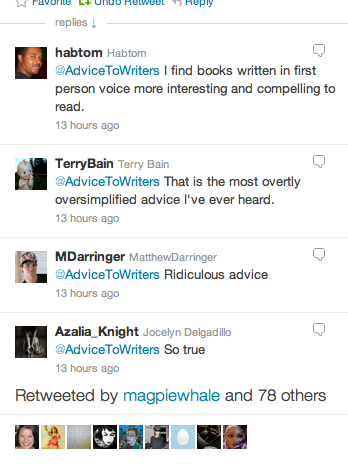
If you were hanging around Twitter when I woke up this morning, you may have seen me get extremely grumpy about a quote from Jonathan Franzen. “Write in the third person,” he says, according to @AdviceToWriters, “unless a really distinctive first-person voice offers itself irresistibly.”

Having just rolled out of bed, I responded in the normal, reasonable way: by getting huffy.

@magpiewhale Not going to lie, this makes me want to write first person out of spite and make it amazing. POV “standards” just. That irritates me.

@magpiewhale Pardon my mulishness, I just woke up. But issuing quips on what you should default to unless you’re extraordinary limits experimentation.

@magpiewhale Not to mention discovery! So I say ignore Franzen and try anything. You’ll figure out what works for your stories.

As I thought about it later, I began to wonder if perhaps I’d skewed Franzen’s meaning a little. Perhaps he’s not being as condescending as he sounds, I thought. Maybe he isn’t speaking to the audience I assume he is, i.e., burgeoning writers. I’ve never read his work, and given the unbearable hype (and boorish subject matter, from what I see of reviews), I don’t actually plan to do so. But I do know how acclaimed he is, for whatever reason, and that his word supposedly carries a note of authority.

Either way, being prescriptive about point of view is irritating and limiting, I feel. As I said in my tweets, artists need to feel free to experiment. If “poorly done” first person is so offensive to a delicate reader’s eye, they’re free to walk away and the writer is free to learn from the experience.

I kept mulling it over, though. And the more I considered the statement, the more inane I found it — because any writer who is exploring a character finds that voice distinctive and irresistible. That’s why they’re using that voice, whatever the POV. The interest is inherent.

All that said, the incident has convinced me of two things. One, I am free from any obligation to read Mr. Franzen’s work. Two, I am thoroughly pleased with my now firm decision to try “Innogen and the Hungry Half” in the first person. It’s not a perspective I use very often, but I look forward to pushing myself with it.

As I congratulate myself for using the word “free” so much in this post, in homage to Mr. Franzen’s latest opus, I have to laugh at myself too. I may disagree with this little bon mot, but in the end, I’m no more authoritative than he is.

eta: Late this evening, @AdviceToWriters posted a different quote that I think is much, much more useful and inclusive.

There are so many different kinds of writing and so many ways to work that the only rule is this: do what works. Almost everything has been tried and found to succeed for somebody. The methods, even the ideas, of successful writers contradict each other in a most heartening way, and the only element I find common to all successful writers is persistence—an overwhelming determination to succeed.

SOPHY BURNHAM

“But clay and clay differs in dignity / Whose dust is both alike.”

I’ve been moping for almost a month now about how I need a new project. The novels are nonstarters, the art is thwarting me and even my resolution to take advantage of Chicago’s cultural offerings hasn’t entirely stuck.

The solution is simple, then: conceive of something straightforward yet grandiose, announce it in front of the whole world, and commit to do it in full view of the public. I would like to try writing a serialized novella, and to post it on a regular schedule here. Since coming to this conclusion on Sunday evening, I’ve been riding the wave of joyous certainty that comes from having a project to plan. I’ve decided to attempt a story I meant to write but never did: a “fork,” if you will, of William Shakespeare’s Cymbeline, set in a steampunk universe.

I’ve never written steampunk before. Truth be told, I haven’t read much either. But I’ve got about five pages of notes, as seen in the illustration above, and I’m ready for an adventure. The story is called “Innogen and the Hungry Half,” which I hope intrigues you, and keeps you coming back for more. Posts will go up at least once (and I’m hoping twice) a week, probably on Tuesdays and Fridays, and I very much hope it becomes a participatory experience. (Translation: I love to hear from you, hi!) You can always find me on Twitter (@magpiewhale), and you can also now follow me on Tumblr (magpieandwhale, shockingly). (I really love Tumblr; I had a post all planned about how cool it is, especially for a site with “magpie” in the title. Then, appropriately enough, I got a bit distracted.)

So that’s it! If you’re totally unfamiliar with Cymbeline, that shouldn’t be a problem with this story, as it takes place before the events of the play. If you’d like to read the play, MIT has the entire text available for free; it is an amazing, hilarious, over-the-top late romance, in which Shakespeare steals liberally from every play he’s written thus far and parodies quite a lot of it, I think. If you’d like a brief trailer to whet your appetite, Cheek By Jowl has very helpfully provided such a thing, featuring the love of my life (who incidentally plays Posthumus and Cloten), Tom Hiddleston.

This double casting of the two male leads is actually what spurred the idea for the story in the first place. I hope to have a lot of conversations about this stuff as this project moves along. For now, though, I’ll leave it here, along with a plea to recommend your favorite Tumblrs to follow — including, if you wish, your own! Happy Monday, folks, and see you shortly in fair Lud’s-town.

Esther by genre

Elphine, a character in Stella Gibbons’ Cold Comfort Farm, spends her days dancing in fields, dressing in fanciful costumes and generally gadding about like a sprite of the woods. She also announces to the heroine, Flora Poste, that she writes poetry. Flora, being the wry Jazz Age society girl (and would-be author) that she is, discourages publicizing such a hobby, particularly to men. Myself, I prefer the opposite tack. If a fella can’t grok that I’m a writer and reader of weird things, we probably wouldn’t get along in the long term anyway.

My OKCupid profile announces near the top that I enjoy writing hard-to-categorize genre fiction. Last week, for the first time, someone sent me a message using that as his hook. How would I categorize my fiction, given the chance? I haven’t yet taken him up on the opportunity to explain in person, but I did start thinking about how I could break down my preferences in an easy-to-digest format.

This won’t be about steampunk or dystopias or paranormal romance. All I know for certain is that I consider myself a fantasy writer: it’s the broadest category that’s always made me happiest. My caveat is that I’m not generally invested in Tolkienesque sword-and-sorcery: my definitive introductory fantasy text wasn’t Lord of the Rings, but Redwall, which took me in some different directions. (As a sidebar, I’m the heretic who adores Peter Jackson’s movies but is bored by the books, save for The Silmarillion, which many people find impenetrable.) I tend to think there’s an internal logic to my genres. Here are my top five.

1. Epics. Blame this on Homer. The bigger and meatier the story, the more I can get lost in the world, the more I love it. The experience of immersing myself in something else entirely is one of the reasons I read and write. Quest stories in particular are really delightful to me, and given that I wrote reams of Redwall and Odyssey spinoffs as a kid, it’s no surprise to me that I have a hard time assembling novels in which the protagonists stay put.

2. Myth, folk tales and fairy tales. There’s something so fascinating to me about authorless stories that everyone within a culture knows. I love how potently these stories become connective tissue within a society, and I’m always impressed by how the telling of these stories is such an important part of the story itself. These are narratives as an act of power, and they change so much in relation to who tells them. That dynamism never stops moving me; I always want to engage.

3. Magical realism. I loved this genre for a long time before I knew the term for it. I’ve always been attracted to the tone and atmosphere of a story where everything seems normal except for one particular thing, or where something becomes literalized — cities are people, books are alive, God is dead and needs to be towed out to sea. The scale of magical realist stories is something I also find inviting: it can be as far-reaching or as personal as you wish.

4. Literary derivations. Two of my ongoing projects are radical reinterpretations of Shakespeare plays — not just retellings from another perspective, but taking those characters and their lives and putting them somewhere entirely new. I’m also working on a version of the Odyssey actually set in space, with all the considerations for psychology and culture that a modern audience demands. I honestly think the value of reinterpreting texts and engaging with them through storytelling cannot be overstated, no matter what the text.

5. Pastiche. I recently finished a story told in the style and conventions of a Jane Austen novel, and it was the most fun I’ve had writing in a long, long time. In the same sense that poetry with strict stylistic requirements gives poets a framework to break and play with, so too does taking on a voice decidedly not your own. The writing can just flow once you’ve figured out the style. It’s a neat way of combining elements of improv and collage, in that you’re operating within a character more than dictating it, and that you’re playing with juxtaposition and combination.

As I look these over, the pattern I notice is how much I’m into reframing and world-building. Perhaps these aren’t as immediately marketable as “werewolf novel” or “deconstructing superheroes” (both of which I love dearly, don’t get me wrong!), but I find I’m not really nervous about that. Like Elphine, I know what I like, and when the time comes, if I can spoil the ending of Cold Comfort Farm a little, I’m confident I can land a guy — or an agent, knock on wood! — who gets that.

Don’t postpone joy.

I don’t remember whether it was for my birthday or for Christmas or some other occasion, but once upon a time a friend of mine gave me a do-it-yourself henna tattoo kit. It was a perfect gift for me, and I was really excited to use it. But I had this notion in my head, that it had to be used at the right time. I looked at the contents once, then put it in a closet, to use when I had an out-of-town friend staying over, maybe, or when I was with someone really dear to me.

The henna tattoo kit stayed in my closet for a long time. I always meant to use it, but somehow the time was never special enough. It wasn’t just something I could do one afternoon because I was bored; this was a present, and ought to be used accordingly. Of course, when I finally did open the package again and test it out – I don’t remember why – the ingredients had degraded, and all I got was a vaguely line-shaped splotch on the back of my hand.

Perfectionism has always been a thing with me, but I never knew the word applied until high school. On the one hand, it makes me incredibly pleased with the work I finish; on the other, it means it takes me a long time to finish just about anything, and even longer to start it. I have an ongoing deal with myself to try and be more satisfied with middle stages and messiness and uncertainty, with not insisting that I choose the timing of every moment of my life. Sometimes it works, sometimes it doesn’t. I try and take it as it comes.

I delay gratification a lot, often for really obscure reasons. Lately I’ve been bribing myself more, to just enjoy things as they come and not soldier on under the promise that someday I’ll deserve something nice for myself. Recently I bought a pair of what are quite possibly the raddest shoes I’ve ever owned, as a birthday present. Just last night I finally cashed in on a new iPod, which I hope will help with my Couch to 5K runs. Last week I attended my first class at StoryStudio, a writing center I’ve been wanting to explore for ages and never quite justified actually doing. (In going through some old emails, I discovered that I’d been on StoryStudio’s mailing list since March 2007, the month I moved back to Chicago. That feels satisfyingly bookend-y, in its way.) The class was on radio essays, and it was an excellent experience on a lot of levels.

My present to myself is feeling like Cab Calloway whenever I want.

This morning on the train, I found myself thinking of the Berenstain Bears. There was a particular book in which Brother and Sister Bear have to knock on the door of a frightening-looking house at the end of a neighborhood street. A witch lives there, or possibly just a mean old woman. Of course, once they do knock on her door, she turns out to be a lovely person who takes them under her wing, and they become friends. I’m not saying that I’m a perfectionist because I’m scared of trying new things, but it is a good reminder that trying new things, and being good to yourself, and not worrying quite so much about whether your experiences will be just as you plan or expect, is a good habit to cultivate.

It’s been a long couple of months since Magpie & Whale was active. A lot has happened, and a lot continues to happen, but nothing has stopped, nor should it. That’s something else I’m working on. Welcome to the flip side, friends. Nice to see you again.